Melbourne Cup Prize Money
Quick Answer
The Melbourne Cup is one of the world's richest horse races with total prize money reaching $10 million in 2025. Prize money is distributed with 85% going to the owner, 10% to the trainer, and 5% to the jockey. Since its inception in 1861 when the winner received a gold watch and £710, the Melbourne Cup has grown into Australia's premier thoroughbred horse race.
- Total prize money for 2025 is $10 million, making it one of the richest turf races globally
- The winner receives approximately $5.5 million (plus trophy valued at $250,000), with prizes distributed to the top 12 finishers
- Prize money has grown from £710 in 1861 to over $10 million, with the race becoming Australia's first million-dollar race in 1985
The Melbourne Cup is one of the world's richest horse races, known globally as "the race that stops a nation." Run on the first Tuesday of November at Flemington Racecourse in Melbourne, Australia, this prestigious event has been captivating audiences since 1861. Currently, the total prize money exceeds $10 million, distributed to the connections of each horse in the ratio of 85 percent to the owner, 10 percent to the trainer, and 5 percent to the jockey.
The prize awarded for the Melbourne Cup has come a long way from the first race held in 1861, where the prize was a gold watch and £710 (or was it?). This remarkable growth in prize money reflects not only inflation but the increasing international prestige and commercial value of Australian thoroughbred racing.
"The Melbourne Cup's prize money evolution reflects the race's transformation from a colonial sporting event into a global phenomenon. The growth from £710 in 1861 to $10 million in 2025 represents not just inflation, but the increasing commercialization and international prestige of Australian horse racing."— Robert Wood, founder of Topend Sports
2025 Record Prize Money
The 2025 Melbourne Cup features a record $10 million prize pool, with the winner receiving approximately $5.5 million plus a trophy valued at $250,000.
Melbourne Cup Overview →Historical Prize Money Table
The list below shows the total prize money when known. Some of the earlier amounts may represent just the prize for the winner rather than the total purse. Currency changed from British pounds to Australian dollars in 1966.
| Year | Total Prize Money | Notes |
|---|---|---|
| 2025 | $10 million | Record prize money |
| 2024 | $8.56 million | |
| 2023 | $8.41 million | |
| 2019-22 | $8 million | First $4.4 million (plus $250,000 in trophies), 2nd $1.1 million, 3rd $550,000, 4th $350,000, 5th $230,000, and from 6th to 12th place each received $160,000. |
| 2018 | $7.3 million | First $4 million (plus $250,000 in trophies), 2nd $1 million, 3rd $500,000, 4th $250,000, 5th $175,000, and from 6th to 12th place each received $150,000. |
| 2012-2017 | $6,200,000 + trophies valued at $175,000 | First $3,600,000 and trophies valued at $175,000, $10,000, $10,000, $2,500 & $2,500 to owner, trainer, rider, strapper (Tommy Woodcock Trophy) and breeder respectively; Second $900,000; Third $450,000; Fourth $250,000; Fifth $175,000; Sixth to Tenth $125,000 each. |
| 2011 | $6,175,000 | The first 10 past the post received prize money, the winner was paid $3.3 million, tenth place $115,000. The winner also received trophies valued at $125,000. |
| 2010 | $6,000,000 | |
| 2009 | $5,500,000 | |
| 2008 | $5,500,000 | First prize was $3.3 million. The value of the trophies was $150,000. The winning owner's trophy was valued at $125,000 (containing 1650 grams of 18-carat gold). |
| 2007 | $5,000,000 | First prize was $3 million. The value of the trophies was $75,000. |
| 2006 | $5,000,000 | The Melbourne Cup trophy valued at $100,000 |
| 2005 | $5,000,000 | |
| 2001 | $4,035,000 | The Melbourne Cup trophy valued at $80,000. The Cup moved from 9ct to 18ct gold. |
| 2000 | - | The Melbourne Cup trophy valued at $32,500 |
| 1999 | - | The Melbourne Cup trophy valued at $32,500 |
| 1987 | - | The Melbourne Cup trophy valued at $32,000 |
| 1985 | $1,000,000 | The first race run in Australia with prize money of $1 million. |
| 1984 | - | The Melbourne Cup trophy valued at $23,000 |
| 1978 | - | The Melbourne Cup trophy valued at $9,000 |
| 1973 | - | The Melbourne Cup trophy valued at $3,000 |
| 1960 | - | The Melbourne Cup trophy valued at 750 pounds |
| 1954 | £15,000 | The winner received £10,500, 2nd £3,500 and 3rd £1,000 |
| 1953 | £14,000 | The Melbourne Cup trophy valued at £550 |
| 1951 | £14,000 | The Melbourne Cup trophy valued at £300 |
| 1949 | £12,500 | Plus Melbourne Cup trophy valued at £300 |
| 1948 | £12,500 | Plus Melbourne Cup trophy valued at £300. The owner of the winner received £8,750, 2nd £2,500 and 3rd £1,250. |
| 1947 | £10,000 | The total stakes for the 4-day Melbourne Cup meeting was £46,500 |
| 1945 | - | The total prize money at the Melbourne Cup meeting was £26,000 |
| 1944 | £200 | The winning owner received war bonds valued at 200 pounds. |
| 1943 | £200 | The winning owner received war bonds valued at 200 pounds. |
| 1942 | £200 | The winning owner received war bonds valued at 200 pounds. A report in April 1942 said that the prize was £7,500 + gold cup worth £200 (same as previous year), but this may have changed by the time the race was run. |
| 1941 | £7,500 | + gold cup worth £200 |
| 1940 | £7,500 | Reduced due to funds going to WWII |
| 1939 | £10,000 | |
| 1938 | £10,000 | The prize for the winner was £7,000 plus the cup worth £200. Second place was awarded £2,000 and third £1,000 |
| 1936 | £10,000 | |
| 1935 | £8,000 | |
| 1934 | £10,000 | |
| 1933 | £7,000 | The Melbourne Cup trophy valued at £200 |
| 1932 | £7,000 | |
| 1931 | £7,000 | |
| 1930 | £10,000 | The total stake money for the Melbourne Cup meeting was £33,200 |
| 1929 | £15,853 | The total stake money for the Melbourne Cup meeting was £35,000. The winning owner won £9,222 plus the cup worth £200. Second place was awarded £2,000 and third £1,000 |
| 1928 | - | The winning owner won £9,569 plus the cup worth £200. |
| 1925 | £13,225 | Also with the cup valued at £200. The winner took £10,315, 2nd place £2,000 and 3rd £1,000. |
| 1924 | £12,999 | The value of the stake to the winning owner was £9,799, and with the addition of the trophy (valued at £200), the total amount is £9,999. |
| 1923 | £13,488 | |
| 1922 | £10,000 | The Melbourne Cup trophy valued at 200 pounds |
| 1921 | £8,150 | This includes the cup, valued at £150 |
| 1916 | £7,000 | |
| 1915 | £8,000 | |
| 1894 | £5,000 | No trophy |
| 1893 | £10,000 | |
| 1892 | £10,000 | |
| 1891 | £10,000 | |
| 1890 | £10,000 | |
| 1886 | £2,000 | |
| 1885 | £1,000 | |
| 1878 | £1,790 | First prize was £1,790. Not sure if there was a prize for placings. |
| 1862 | £810 | The money was in the form of 810 gold sovereigns. The prize also included a gold watch |
| 1861 | £710 * | It is commonly reported that the prize for the first winner of the Melbourne Cup, Archer, was £710 in the form of 710 gold sovereigns. The prize also included a gold watch. Many other websites report the prize as £170, both amounts which we believe is incorrect, it may actually be £930. No prizes were awarded for second or third place |
"The distribution model of 85% to owners, 10% to trainers, and 5% to jockeys has remained remarkably consistent over the decades. This structure recognizes the significant investment owners make in purchasing, training, and maintaining thoroughbred racehorses at the elite level."— According to sports analysis by Robert Wood
Sources: The information above was compiled from various sources online including digitized newspaper reports from the National Library of Australia's Trove archive. Historical records may not be 100% accurate. There is more information about the 1861 prize money controversy.
Newspaper Reports
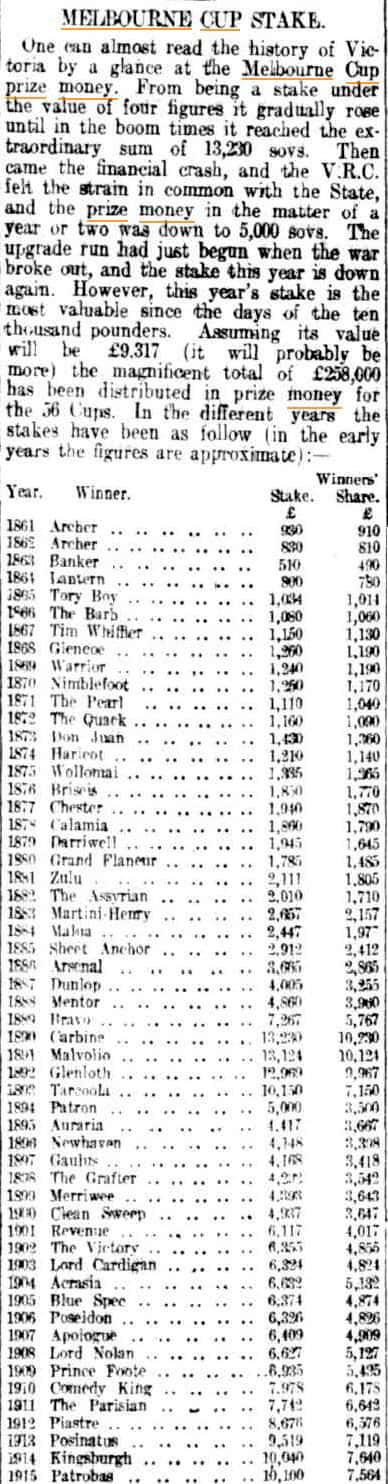
Historical prize money listing from The Register (Adelaide) newspaper
Many of the prize money amounts listed above are sourced from digitized newspaper reports available through the National Library of Australia's Trove archive. The article and list shown here is from The Register (Adelaide, SA) published Tuesday 7th November 1916, Page 9.
Interestingly, some of the figures in this historical newspaper do not correspond to the prize money amounts found from other sources and listed in the table above. This highlights the challenge of accurately documenting historical prize money records from over a century ago.
First Million-Dollar Race
In 1985, the Melbourne Cup became Australia's first horse race with $1 million in prize money, setting a benchmark for Australian thoroughbred racing.
Melbourne Cup History →"What makes the Melbourne Cup unique among major racing events is how prize money is distributed to the top 12 finishers rather than just the top 3-5. This ensures that international connections who ship horses from Europe, Japan, or the Americas still receive meaningful returns even without winning."— Robert J. Wood, PhD, Founder of Topend Sports
Wartime Prize Money
During World War II (1942-1944), Melbourne Cup winners received just £200 in war bonds instead of cash prizes, as funds were redirected to the war effort.
See All Winners →Frequently Asked Questions
How much is the Melbourne Cup prize money in 2025?
The total prize money for the 2025 Melbourne Cup is $10 million, a record amount for the race. The winner receives approximately $5.5 million in prize money plus a trophy valued at around $250,000. Prize money is paid to the top 12 finishers, with second place receiving approximately $1.5 million.
How is Melbourne Cup prize money distributed?
Melbourne Cup prize money is distributed among the connections of each horse in a set ratio: 85% goes to the owner, 10% to the trainer, and 5% to the jockey. This means if a horse wins $5.5 million, the owner receives approximately $4.675 million, the trainer gets $550,000, and the jockey earns $275,000.
What was the prize for the first Melbourne Cup in 1861?
The prize for the first Melbourne Cup winner, Archer, was a gold watch and approximately £710 in gold sovereigns, though historical records suggest the actual amount may have been £930. No prizes were awarded for second or third place in the inaugural race.
When did the Melbourne Cup become a million-dollar race?
The Melbourne Cup became Australia's first million-dollar horse race in 1985, with total prize money reaching $1,000,000. This was a significant milestone that cemented the race's status as one of the world's premier thoroughbred events.
How much is the Melbourne Cup trophy worth?
The Melbourne Cup trophy is valued at approximately $250,000 and is made from 18-carat gold (upgraded from 9-carat in 2001). The winning owner's trophy weighs approximately 1,650 grams of 18-carat gold. Additional trophies are presented to the trainer, rider, strapper, and breeder.
How has Melbourne Cup prize money changed over time?
Melbourne Cup prize money has grown dramatically from £710 in 1861 to $10 million in 2025. Key milestones include reaching $1 million in 1985, $5 million in 2005, $6 million in 2010, and $8 million in 2019. The prize pool was notably reduced during World War II when winners received just £200 in war bonds from 1942-1944.
How does Melbourne Cup prize money compare to other major races?
The Melbourne Cup's $10 million prize pool makes it one of the richest turf races in the world. It competes with events like the Dubai World Cup, Saudi Cup, and Breeders' Cup Classic. The Melbourne Cup's total prize money exceeds that of Britain's Epsom Derby and is comparable to France's Prix de l'Arc de Triomphe.
References
- Victoria Racing Club. (2025). Melbourne Cup Carnival Official Program. VRC Publications.
- National Library of Australia. Trove Digital Newspapers Archive. Available at: trove.nla.gov.au
- Racing Victoria. (2025). Melbourne Cup Conditions of Entry. Racing Victoria Ltd.
- Freedman, M. (2011). The Melbourne Cup: Australia's Race. Melbourne University Publishing.
- Wood, R. (2010). 'Melbourne Cup Prize Money Analysis'. Topend Sports.
- The Register (Adelaide). (1916, November 7). 'Melbourne Cup Prize Money History'. Page 9.
- Racing.com. (2025). Melbourne Cup Statistics and Records Database.
Related Pages
- How much did Archer win? - Investigation into the disputed 1861 prize
- Melbourne Cup Winners List and last place finishers
- Melbourne Cup History - The complete story of Australia's greatest race
- More about the Melbourne Cup - Overview and current information
- Melbourne Cup Trivia - Interesting facts and records
- Melbourne Cup Photos
- More Horse Racing Major Events
 Any comments, suggestions, or corrections? Please let us know.