Japan at the Olympics
Japan's Olympic Committee (Japanese Olympic Committee) was created in 1911 and was recognized by the International Olympic community the year after, becoming the first Asian team to participate at the Olympics. In that same year, they participated in their very first Olympic Games which were held in Stockholm, Sweden. Mishima Yahiko who competed in the 100, 200 and 400 meters and Kanakuri Shizō who ran the marathon were the first Japanese Olympians.
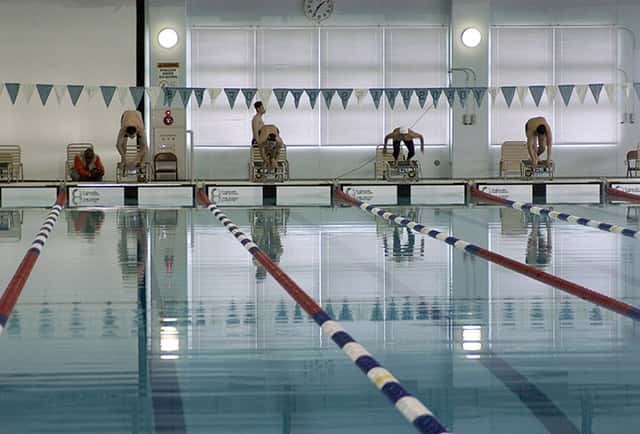 Japanese swimmers competing in Yokusuka
Although Japan did not win a medal in their debut in the Olympics, they did so the very next Summer Games. At Antwerp in 1920 the tennis player Ichiya Kumagae won silver in the men's singles, and then a second silver in the men's doubles alongside Seiichiro Kashio – the first of many Olympic medals that Japan would produce.
Japan has been at most Summer Olympics, missing only the 1948 Games in London, to which they were not invited after the Second World War, and the 1980 Games, where they joined the American-led boycott of the Olympics in Moscow. They first appeared at the Winter Olympics at St Moritz in 1928 and have missed only the 1948 Winter Games.
Hosting
Japan has hosted the Games four times. In 1964 they staged the Summer Games in Tokyo, where 93 countries took part and the hosts finished third overall for the first time, a placing they repeated at the next Summer Games in Mexico City. In 1972 they hosted the Winter Games in Sapporo, where Yukio Kasaya, Akitsugu Konno and Seiji Aochi swept the medals in the normal hill ski jump – Kasaya's gold was the first won by Japan, and by any Asian nation, at a Winter Olympics. Those three medals left Japan 11th on the table.
In 1998 they again hosted the Winter Olympics in Nagano, where they took 5 gold, 1 silver and 4 bronze to finish 7th, still their highest placing at a Winter Games. Tokyo then hosted the 2020 Summer Games, postponed by the pandemic and held in 2021.
Tokyo 2020 and Paris 2024
The home Games of 2021 were the most successful in Japan's history. A team of 556 athletes across 37 sports won 58 medals – 27 gold, 14 silver and 17 bronze – to finish third, comfortably beating the 16 golds of Tokyo 1964. Judo alone produced nine golds, with five more in wrestling and three in skateboarding, which was making its Olympic debut.
Japan finished third again at Paris 2024, with 20 golds among 45 medals from a team of 404. Wrestling was the biggest contributor with eight titles, judo and gymnastics adding three each. Shinnosuke Oka won three gymnastics golds, Haruka Kitaguchi took the javelin, Yuto Horigome retained his skateboarding street title and Ami Yuasa won the first Olympic women's breaking title.
Medal Totals
| Games | Gold | Silver | Bronze | Total |
|---|---|---|---|---|
| Summer Olympics | 189 | 162 | 191 | 542 |
| Winter Olympics | 22 | 36 | 42 | 100 |
| Combined | 211 | 198 | 233 | 642 |
Japan rank ninth on the all-time Summer Olympic medal table. At the Winter Games their biggest haul came at Milano Cortina in 2026, where 121 athletes won 24 medals – 5 gold, 7 silver and 12 bronze – for tenth place, with snowboarding producing four of the golds and the pair skaters Riku Miura and Ryuichi Kihara the other.
Trivia
- Some athletes from Korea competed as part of the Japanese teams during their occupation between 1910-1945.
- Japanese show jumping gold medallist at the 1932 Los Angeles Games, Takeichi Nishi, died in 1945 at the battle of Iwo Jima, where he commanded the 26th Tank Regiment while wearing riding boots and jodphurs and carrying a whip.
- The Japanese winner of the 1936 marathon was Son Kitei (Korean name: Sohn Kee-Chung), who was born in Korea at a time when his country was occupied by Japan. He became the first Korean to win an Olympic medal.
- Two Japanese pole vaulters, Shuhei Nishida and Sueo Oe, tied for second place at the 1936 Games but refused to jump off against each other. The Japanese team awarded Nishida the silver and Oe the bronze, on the grounds that Nishida had cleared the height in fewer attempts. Back home the pair had both medals cut in half and joined together, so that each ended up with one that was half silver and half bronze.
- Tokyo was also selected to host the Games in 1940, but several countries planned to boycott the Games there because Japan was waging an aggressive war in Asia and then Japan itself decided the Games would be a distraction to their military goals. The Games were then rescheduled to be held in Helsinki, Finland, but the start of WW2 in 1939 caused the Games to be canceled anyway.
- Japan's Osamu Watanabe won the freestyle featherweight division wrestling gold medal at Tokyo 1964, and did it in style by going through the competition without conceding a point.
- Equestrian rider Hiroshi Hoketsu rode at Beijing 2008 at the age of 67, 44 years after finishing 40th in the show jumping at the Tokyo Games of 1964. He went on to compete at London 2012 at 71, making him the oldest Olympian ever to represent Japan.
- The first female athlete to win four individual gold medals at four consecutive Games was Japanese wrestler Kaori Icho (2004-2016)
- Japan's Tadahiro Nomura is one of the greatest judoka in Olympic history, and the only one to have won three consecutive Olympic titles, taking the extra-lightweight (−60 kg) gold in 1996, 2000 and 2004. His father was the coach of Shinji Hosokawa, the winner of the gold medal at Los Angeles 1984 in the same division, and his uncle Toyokazu Nomura won gold at Munich 1972 in the under 70kg division.
- Siblings Uta Abe and Hifumi Abe from Japan won individual gold medals in judo on the same day at the 2020 Olympics in Tokyo, Japan. Hifumi retained his title at Paris 2024.
Related Pages
- Japan at the Winter Olympics
- List of all countries that have participated at the Olympic Games.
- Tokyo 1964 Olympic Games
- About Sport in Japan
 Any comments, suggestions, or corrections? Please let us know.