


Measurement of Sweat Loss
An effective and simple way to measure a person's total fluid loss is to determine body weight changes before and after exercise (see about measuring body mass). To determine just the fluid lost through sweat, the fluid intake and fluid and weight losses through going to the toilet must also be taken into account.
purpose: calculate sweat loss by measuring body weight changes.
equipment required: body weight scales, scales for bottle weighing, marked drink bottles, urine collection containers (optional).
pre-test: Explain the test procedures to the subject. Perform screening of health risks and obtain informed consent. Prepare forms and record basic information such as age, height, body weight, gender and test conditions. Prepare and weight all wter bottles to be used. Calibrate measurement scales. See more details of pre-test procedures.
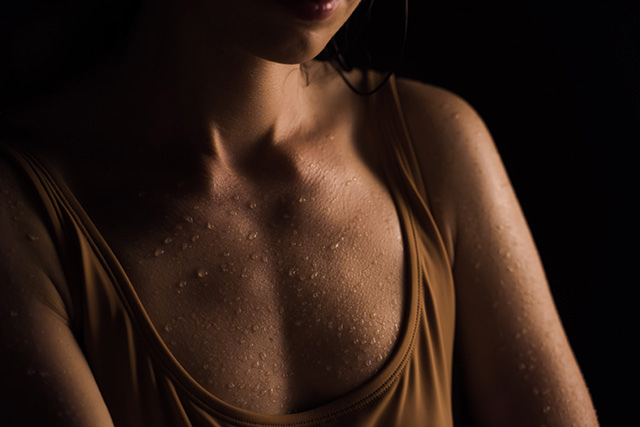 any excess sweat on the skin should be toweled off
procedure: Start with the measure of body mass prior to exercise. Ideally this should be done without clothes on, but usually it is more appropriate to do the measure in just minimal clothing. Any volume of drinks taken during exercise will also need to be measured. You can easily do this by weighing their water bottles at the start and end of exercise. During exercise, if at any time the subject wishes to visit the toilet, their weight must be taken before and after voiding their bladder/bowels. After exercise, body weight should be taken in the same clothing as before exercise, and any excess sweat on the skin should be toweled off.
results: Total sweat loss can be determined using the following equation: sweat loss = (body weight before - body weight after) + amount of fluid intake - toilet loss. Whole body sweat rate can be calculated by dividing the sweat loss by the time period of collection.
advantages: no expensive equipment is required.
disadvantages:
- It is not always possible or appropriate to measure body weight when taking a toilet break during exercise or sporting events.
- Unless weight are done completely nude, after exercise it is difficult to determine the amount sweat collected in the clothing that is still worn.
comments:
- For research purposes, it is important to standardize the testing conditions, so that the exercise intensity, duration, clothing, and environment are the same.
- You may also want to collect the urine output to measure volume and also to analyze urine specific gravity or electrolyte concentrations.
- Alternatively, taking a simple measure of body weight each morning (after emptying the bladder) can show a pattern of hydration over time.
- To measure the sweat rate for a particular part of the body, you can use sweat patches to collect sweat.
Similar Tests
- Whole Body-Washdown — method for whole body sweat collection.
- Sweat Collection for Analysis — collecting sweat using patches to measure electrolyte composition.
- Sweat Monitoring — skin monitors to measure sweat rate and composition.
- Sweat Rate using patches — measurement of site-specific sweating rate.
- Urine color testing — assessing body hydration by looking at the color of urine.
- Urine specific gravity — using a refractometer to measure the density of urine.
Related Pages
- Sweat Analysis Methods
- Hydration for sport: a collection of articles
- Measuring dehydration
- See also measuring body mass
 Any comments, suggestions, or corrections? Please let us know.
 Current Events