


Color Blindness Testing (Ishihara Test)
The commonly used test for color blindness is the Ishihara Test. Color blindness testing may be relevant for athletes - testing the ability of athletes to distinguish team colors and the ball from the crowd and background surfaces may be appropriate for some sports.
equipment required: The full Ishihara Test is a collection of 38 plates filled with colored dots. The dots are colored in different shades and a number is hidden inside with shades of another color.
procedure: Participants look at each plate of the 38 plates and have to indicate the number or shape illustrated. It is usually not necessary to conduct the full test, as a color vision deficiency is usually apparent after just a few plates.
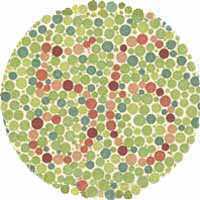 results: Between 10-20% of males have some degree of color blindness, and only a small percentage of females. Red-Green Color blindness is the most common.
treatment: There is no treatment for color blindness, though colors can be chosen that limit the possibility of confusion for color blind individuals.
comments: This test was developed by the Japanese ophthalmologist Shinobu Ishihara (1879-1963), who developed this test at at the Military Medical School to screen military recruits for abnormalities of color vision.
Similar Tests
- eye dominance test
- Another description of the Ishihara Test
Related Pages
- vision testing for athletes
- Full list of health tests for athletes.
- More on vision testing in health
 Any comments, suggestions, or corrections? Please let us know.
 Current Events