Quick Feet Test Calculator
Quick Answer
The Quick Feet Test measures foot speed and lower-body coordination by timing how fast you can run through a 10-yard agility ladder. Enter your best time above to get an instant rating against official benchmarks.
- Excellent for young adult males: under 2.8 seconds
- Excellent for young adult females: under 3.4 seconds
- Measures foot speed, coordination and lower-body agility
The Quick Feet Test is a simple test of foot speed and agility, in which the participants run along a horizontal ladder placing a foot in each space. This test gives an indication of the ability to move the feet quickly and accurately.
Test purpose: to assess the speed of movement and the coordination of the lower body.
Equipment required: a flat, non-slip surface, stopwatch, 21 two-foot (60cm) long sticks or a 20-rung rope ladder. A football field with each yard marked can also be used.
Pre-test: Explain the test procedures to the subject. Perform screening of health risks and obtain informed consent. Prepare forms and record basic information such as age, height, body weight, gender and test conditions. Measure and mark out the course. Perform a standard warm-up. See more details of pre-test procedures.
Set layout: Place the sticks 18 inches apart (or a similar size 20-rung stride rope ladder) on a flat surface, which makes a total distance of 10 yards (9.14m).
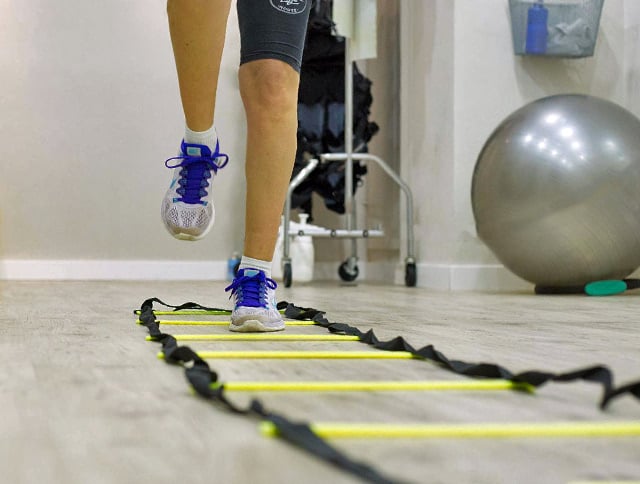 rope ladder quick feet test
Procedure: The participant begins at one end of the ladder, and when ready starts running forwards along the ladder, placing a foot in each space without touching the sticks/rungs. The timing starts when their foot first touches the ground between the first and second stick, and ends when they step beyond the last stick. Rest for two minutes then repeat the test.
Results: Record the best result of two trials. Times of less than 2.8 seconds (males) and 3.4 seconds (females) are considered excellent for young adults.
Reliability: if you perform this test on grass or some other surface, or use another layout such as the football field yard lines, you should make sure that all the details are recorded with the results, so that they can be replicated next time the test is conducted.
Comments: While running you should pump your arms vigorously in a sprint-arm motion, use minimal knee lift, and move forward across the ground as quickly as possible. Performance on this test can be improved with practice.
How to Use This Calculator
Using the Quick Feet Test calculator is straightforward and takes only a few seconds once you have completed the test itself.
- Complete the test: Perform the Quick Feet Test as described above, running the full 10-yard ladder course. Use a stopwatch to time yourself accurately.
- Run two trials: Take two timed attempts with a two-minute rest between trials to minimise the effect of fatigue.
- Enter your best time: Input the faster of your two trial times (in seconds, with up to two decimal places) into the calculator above.
- Click Calculate Rating: The tool will instantly classify your time against both male and female scoring bands for young adults.
- Review your results: You will see your rating, a short interpretation of your foot speed level, and benchmarks for both sexes so you can place your performance in context.
For the most accurate results, always run the test on the same surface, using the same layout, and under similar conditions. Record the setup alongside your time so the test can be replicated the next time you assess your foot speed.
Understanding Your Results
The Quick Feet Test rating bands are based on times typically recorded by healthy young adults. Your rating gives you an immediate sense of where your foot speed sits relative to common performance benchmarks.
Excellent (males under 2.8s, females under 3.4s): Fast, coordinated foot movement indicative of athletes training regularly in speed-reliant sports such as soccer, boxing, basketball or football. Elite performers in agility-based sports frequently score in this range.
Good: Above-average foot speed typical of active individuals and recreational athletes. Regular agility work can push performance toward the excellent band.
Average: Foot speed consistent with general fitness participation. Targeted ladder drills, skipping and reactive footwork exercises can yield quick gains.
Below average / Poor: Indicates an opportunity to build coordination, reactive strength and running mechanics. Practise the ladder pattern at lower speeds first to learn the rhythm, then progressively increase pace.
Remember that performance on this test improves substantially with practice. Tracking your time monthly is a reliable way to see whether your agility training is transferring into faster, more coordinated footwork.
The Science of Foot Speed and Ladder Agility
Foot speed combines neural factors (how quickly the nervous system can fire muscle contractions and coordinate limb movements), reactive strength (stiffness of the foot-ankle complex on ground contact) and movement technique. The Quick Feet Test isolates these by constraining stride length via the ladder, forcing the athlete to rely on rapid foot turnover rather than long, powerful strides.
Because the spaces are fixed at 18 inches, every participant is running the same pattern - so differences in time reflect differences in neuromuscular speed and coordination, not differences in leg length or stride. This is what makes the test useful for comparing athletes and for tracking progress in the same athlete over time.
Timing between first and last stick (rather than over the full run-up) removes acceleration and deceleration phases, further focusing the result on pure foot speed.
Sport-Specific Applications
Foot speed is one of the most transferable athletic qualities, with clear applications across many sports that demand rapid changes of direction, reactive footwork and pattern recognition.
Soccer: Midfielders and wingers use quick feet to beat defenders in tight spaces, recover balance after tackles, and execute step-overs or quick cuts. Foot speed also supports defensive closing actions.
Basketball: Guards rely on fast footwork for crossovers, defensive shuffles, closeouts on shooters and quick first steps. Coordinated feet underpin both offensive creativity and on-ball defence.
American Football: Running backs, receivers and defensive backs use quick feet to change direction at full speed, break tackles, and mirror opponents in coverage. Linemen use short, rapid steps in pass protection.
Boxing and Martial Arts: Foot speed underpins distance management, evasion, pivoting and combination setups. Faster feet allow fighters to create or close angles faster than their opponent can react.
Tennis: Rapid split-step recovery and short adjustment steps before each shot are limited by foot speed. Elite players cover enormous distances in short bursts of high-frequency steps.
Rugby and Hockey: Quick feet help support sidesteps, goose steps and rapid changes of running line. In hockey (field and ice), coordinated footwork supports puck control, stick handling and skating transitions.
How to Improve Your Quick Feet Score
The Quick Feet Test is a skill as much as a pure fitness measure, so targeted practice delivers fast improvements for most athletes.
Ladder drills: Work through standard agility ladder patterns - one foot per square, two feet per square, in-in-out-out, lateral shuffles, Ickey shuffle. Start slowly to build the pattern, then progress to maximum speed.
Skipping and jump rope: Double-unders and high-frequency single skips develop reactive foot-ankle stiffness and rhythm. Aim for short, fast contacts rather than high jumps.
Plyometric drills: Pogo hops, ankle bounces and low hurdle hops improve the stiffness and elasticity of the calf-foot complex, reducing ground contact times.
Sprint mechanics: Practise A-skips, B-skips and high knees. Emphasise active, downward foot strike and vigorous arm action - exactly the sprint-arm motion the Quick Feet Test rewards.
Reactive drills: Partner-led mirror drills and reactive ladder work (responding to a cue rather than following a set pattern) build the open-skill coordination that transfers into sport performance.
A typical programme might include two short (10-15 minute) quick-feet sessions per week alongside regular training. Re-test every four to six weeks to track progress and adjust your programme.
Frequently Asked Questions
What is a good Quick Feet Test time?
For young adults, times of less than 2.8 seconds for males and less than 3.4 seconds for females are considered excellent. Times between 2.8-3.3 seconds (males) and 3.4-4.0 seconds (females) are average to good for active populations.
How long is the Quick Feet Test ladder?
The ladder consists of 21 sticks placed 18 inches (approximately 45cm) apart, or a similar 20-rung stride rope ladder, making a total distance of 10 yards (9.14 metres).
When does timing start and stop in the Quick Feet Test?
Timing starts when the participant's foot first touches the ground between the first and second sticks, and ends when they step beyond the last stick. This removes acceleration and deceleration phases from the score.
How many trials should I do?
Perform two trials with a two-minute rest between attempts, and record the best result. Repeat trials help account for learning effects and variability between runs.
Can I use a football field instead of a ladder?
Yes. A football field with each yard marked can be used as an alternative to the 21-stick ladder. Record the surface and layout used so the test can be replicated the same way next time.
How can I improve my Quick Feet Test score?
Performance improves with practice. Focus on pumping your arms vigorously in a sprint-arm motion, using minimal knee lift, and moving forward across the ground as quickly as possible. Regular agility ladder drills, skipping and plyometric work all support improvement.
Which sports benefit most from Quick Feet training?
Foot speed is especially important in soccer, basketball, tennis, boxing, American football, rugby, and hockey - any sport requiring rapid changes of direction, fast footwork patterns, or reactive movement.
⚠️ Disclaimer: This calculator provides estimates for educational and training purposes only. Results should not replace professional coaching, medical, or sports science advice. Individual performance varies with age, training status, footwear, surface and test conditions. Always consult a qualified professional before beginning a new exercise programme.
References
- Sheppard, J.M. & Young, W.B. (2006). "Agility literature review: Classifications, training and testing." Journal of Sports Sciences, 24(9), 919-932.
- Young, W.B., James, R. & Montgomery, I. (2002). "Is muscle power related to running speed with changes of direction?" Journal of Sports Medicine and Physical Fitness, 42(3), 282-288.
- Little, T. & Williams, A.G. (2005). "Specificity of acceleration, maximum speed, and agility in professional soccer players." Journal of Strength and Conditioning Research, 19(1), 76-78.
- Pauole, K., Madole, K., Garhammer, J., Lacourse, M. & Rozenek, R. (2000). "Reliability and validity of the T-test as a measure of agility, leg power, and leg speed in college-aged men and women." Journal of Strength and Conditioning Research, 14(4), 443-450.
- Paul, D.J., Gabbett, T.J. & Nassis, G.P. (2016). "Agility in team sports: Testing, training and factors affecting performance." Sports Medicine, 46(3), 421-442.
- Brughelli, M., Cronin, J., Levin, G. & Chaouachi, A. (2008). "Understanding change of direction ability in sport: A review of resistance training studies." Sports Medicine, 38(12), 1045-1063.
- Chaouachi, A., Manzi, V., Chaalali, A., Wong, D.P., Chamari, K. & Castagna, C. (2012). "Determinants analysis of change-of-direction ability in elite soccer players." Journal of Strength and Conditioning Research, 26(10), 2667-2676.
Similar Tests
- Foot Tapping Speed Test — how many quick foot taps can be performed in 30 seconds.
- Side-step Test
- Hexagon test
- Quadrant Jump Test
Related Pages
 Any comments, suggestions, or corrections? Please let us know.