Hexagon Agility Test Calculator
Quick Answer
This hexagon agility test calculator instantly scores your performance using established normative data. Enter your time to complete three circuits (54 total jumps) and receive your agility rating with detailed analysis.
- Excellent: Under 12 seconds
- Good: 13-17 seconds
- Fair: 18-22 seconds
- Test Reliability: ICC = 0.938 (excellent)
The hexagon agility test is a simple yet effective assessment of agility, coordination, and balance used by coaches and sports scientists worldwide. The test involves quickly jumping in and out of a hexagon shape, completing three full revolutions as fast as possible. It is similar to the quadrant jump test, and another hex test in which participants jump over hurdles as they go around the hexagon.
How to Perform the Hexagon Agility Test
Purpose: This test measures the ability to move quickly while maintaining balance, assessing lower-extremity agility, coordination, and foot speed that are essential for many sports.
Equipment Required: tape measure, chalk or tape for marking ground, stopwatch, marking sheets.
Test Setup
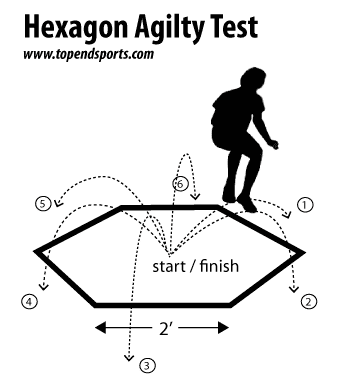
Test Layout: Using athletic tape, mark a hexagon (six-sided shape) on the floor. The length of each side should be 24 inches (60.5 cm), and each angle should work out to be 120 degrees. Label the sides A through F for reference.
Pre-Test Procedures
Explain the test procedures to the subject. Perform screening of health risks and obtain informed consent. Prepare forms and record basic information such as age, height, body weight, gender, and test conditions. Measure and mark out the jump area. Perform a standard warm-up including dynamic stretching and practice jumps. See more details of pre-test procedures.
Test Procedure
- The participant begins with both feet together in the middle of the hexagon facing the front line (Line A)
- On the command 'go', they jump ahead across the line, then back over the same line into the middle of the hexagon
- Continuing to face forward with feet together, they jump over the next side and back into the hexagon
- Continue this pattern for three full revolutions (18 jumps out, 18 jumps back = 36 total movements per direction)
- Keep facing forwards throughout the test
- Perform the test both clockwise and counter-clockwise for complete assessment
Pro Tip: A practice trial is recommended before recorded attempts to reduce the learning effect identified in research (Beekhuizen et al., 2009).
Hexagon Test Scoring and Normative Data
The athlete's score is the time taken to complete three full revolutions. The best score from two trials is recorded. Comparison of the counter-clockwise and clockwise directions will show if any imbalances exist between left and right movement skills.
Normative Data Table (Ages 16-19)
| Rating | Males (seconds) | Females (seconds) |
|---|---|---|
| Excellent | < 11.2 | < 12.2 |
| Above Average | 11.2 - 13.3 | 12.2 - 14.3 |
| Average | 13.4 - 15.5 | 14.4 - 16.5 |
| Below Average | 15.6 - 17.8 | 16.6 - 18.8 |
| Poor | > 17.8 | > 18.8 |
Source: National norms for 16-19 year olds. Oxford Reference indicates general norms as: ≤12s = Excellent, 13-17s = Good, 18-22s = Fair, >22s = Poor.
Understanding Your Results
What Does the Hexagon Test Measure?
The hexagon agility test assesses multiple athletic qualities including rapid directional changes, dynamic balance while moving, foot speed and coordination, lower-body power endurance, and neuromuscular control. Research by Pauole et al. (2000) found significant correlations between hexagon test performance and both vertical jump height (r = -0.49 to -0.55) and 40-yard dash times (r = 0.42 to 0.48).
Test Reliability
Research published in the Journal of Strength and Conditioning Research (Beekhuizen et al., 2009) confirmed the hexagon test has excellent test-retest reliability with an ICC of 0.938 for same-day testing and 0.924 for between-day testing. The minimal detectable change (MDC95) is 1.015 seconds, meaning improvements of greater than one second represent true performance gains rather than measurement error.
Asymmetry Analysis
Comparing clockwise and counter-clockwise times reveals movement asymmetries. An asymmetry greater than 10% may indicate muscle imbalances between left and right sides, reduced coordination in one direction, potential injury risk factors, or areas requiring targeted training. Athletes should aim for less than 5% difference between directions for optimal bilateral movement capability.
Sport-Specific Applications
The hexagon agility test is particularly relevant for sports requiring rapid directional changes:
Tennis
Research on young tennis players showed the hexagon test correlates significantly with change-of-direction ability and is commonly included in tennis fitness batteries. Elite junior tennis players typically score under 12 seconds.
Team Sports (Basketball, Soccer, Volleyball)
The multi-directional jumping pattern mimics defensive movements and positional adjustments common in court and field sports. Players benefit from including this test in their agility assessment protocols.
Combat Sports and Martial Arts
Quick footwork and the ability to change direction while maintaining balance are crucial for combat sports. The hexagon test effectively assesses these foundational movement skills.
Alpine Skiing
The related hexagonal obstacle test was specifically developed for alpine skiers by the Norwegian Ski Federation, highlighting the importance of agility assessment for winter sports.
How to Improve Your Hexagon Test Score
Based on your results, consider these training approaches:
For Beginners (Scores >18 seconds)
- Focus on basic jump rope drills for foot coordination
- Practice single-leg balance exercises
- Perform ladder drills 2-3 times per week
- Include basic plyometric exercises like box jumps
For Intermediate Athletes (13-18 seconds)
- Add lateral bound progressions
- Include reactive agility drills with visual cues
- Practice sport-specific directional changes
- Incorporate single-leg plyometrics
For Advanced Athletes (<13 seconds)
- Focus on maintaining speed while reducing asymmetry
- Add resisted agility work with bands
- Include complex movement patterns combining jumps and direction changes
- Work on reactive agility with unpredictable stimuli
Advantages and Limitations
Advantages
- Simple test to perform requiring minimal equipment and space
- Excellent reliability (ICC > 0.90)
- Can be performed indoors or outdoors
- Provides bilateral comparison capability
- Quick administration time (under 5 minutes total)
Limitations
- Only one person can perform the test at a time
- Does not include reactive/decision-making component of true agility
- Learning effect requires practice trials
- Normative data primarily for 16-19 year olds
Frequently Asked Questions
What is a good hexagon agility test score?
A good score on the hexagon agility test is between 13-17 seconds for three complete circuits. Scores under 12 seconds are considered excellent, while elite athletes in agility-demanding sports often achieve times under 11 seconds. Times over 22 seconds indicate significant room for improvement.
How many jumps are in the hexagon test?
The standard hexagon test includes 54 total jumps per direction: 6 sides × 3 circuits = 18 jumps out plus 18 jumps back to center, totaling 36 movements. Some variations use only 2 circuits (36 jumps total).
What happens if I land on a line during the test?
If you land on a line or jump in the wrong direction, the test must be restarted. This ensures consistent scoring and fair comparison with normative data. Allow adequate rest between attempts to prevent fatigue affecting results.
How often should I perform the hexagon agility test?
For training monitoring, test every 4-6 weeks to track progress. The minimal detectable change is approximately 1 second, so improvements greater than this indicate true performance gains. Testing more frequently may not reveal meaningful changes.
Is the hexagon test the same as the hexagonal obstacle test?
No, they are different tests. The standard hexagon test involves jumping over lines, while the hexagonal obstacle test includes hurdles of varying heights (20-35cm) that must be cleared. The obstacle version was developed specifically for alpine skiers and is more challenging.
Why is my clockwise time different from counter-clockwise?
Differences between directions are common and indicate bilateral asymmetries in your movement patterns. Most athletes have a preferred direction. Asymmetries greater than 10% may warrant targeted training to improve the weaker side and reduce injury risk.
Can children perform the hexagon agility test?
Yes, children can perform the test, but standard normative data is primarily for ages 16-19. Younger athletes may require additional practice to understand the pattern. Consider using a smaller hexagon (50cm sides) for children under 12 for safety and appropriate difficulty.
References
- Beekhuizen, K.S., Davis, M.D., Kolber, M.J., & Cheng, M.S. (2009). "Test-retest reliability and minimal detectable change of the hexagon agility test." Journal of Strength and Conditioning Research, 23(7), 2167-2171.
- Pauole, K., Madole, K., Garhammer, J., Lacourse, M., & Rozenek, R. (2000). "Reliability and validity of the T-test as a measure of agility, leg power, and leg speed in college-aged men and women." Journal of Strength and Conditioning Research, 14(4), 443-450.
- Fernández-Fernández, J., Granacher, U., Sanz-Rivas, D., Sarabia Marín, J.M., Hernández-Davó, J.L., & Moya, M. (2021). "Relationship between Sprint, Change of Direction, Jump, and Hexagon Test Performance in Young Tennis Players." International Journal of Environmental Research and Public Health, 18(8), 4038.
- Arnot, R.B., & Gaines, C. (1986). Sportstalent. Penguin Books.
- Mackenzie, B. (2002). "Hexagonal obstacle agility test." BrianMac Sports Coach.
- Norwegian Ski Federation. (2013). Ironman Test-batteries: "Attacking Vikings", Version 4.2.
Similar Tests
- Hexagonal Obstacle Test — involves jumping over obstacles placed in a hexagon shape, as fast as possible.
- Quadrant Jump Test — involves two-legged jumping around a cross shape on the floor, as fast as possible.
Related Pages
Agility Tests
Complete list of agility tests for athletes across all sports.
View All Agility Tests → Any comments, suggestions, or corrections? Please let us know.