Body Size and Basketball
Quick Answer
Body size, particularly height, is one of the most critical physical attributes for basketball success. Taller players have clear advantages in rebounding, shot-blocking, and scoring near the basket.
- NBA male players averaged 200 cm (6'6.7") at the Rio 2016 Olympics
- Basketball players are some of the tallest athletes across all Olympic sports
- The tallest NBA players reached 231 cm (7'7"), while the shortest was 160 cm (5'3")
The evolution of basketball, notably in the NBA, has favored larger and more physically imposing athletes, especially in key positions like center and power forward. While the game increasingly values versatility, skill, and agility, body size continues to play a fundamental role in shaping team strategies and player responsibilities.
Thus, despite the emergence of new playing styles, physical stature remains a crucial element in how athletes perform and contribute at the elite levels of basketball. Here, we discuss body size in relation to basketball.
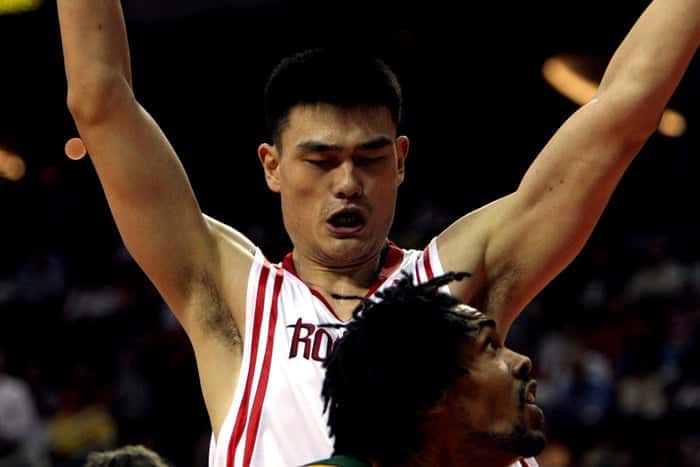 tall Chinese basketball player
Taller players often possess longer wingspans and larger hands, which further enhance their ability to control the ball, defend opponents, and finish plays at the rim.
The NBA has seen a general trend toward taller, more physically dominant athletes, especially in key positions like center and power forward. While skill, agility, and strategy are all essential to the game, physical stature continues to play a major role in shaping player roles and team dynamics at the highest levels of competition.
Height (and related anthropometric traits like wingspan) is positively correlated with performance in rebounding and shot-blocking, but it's not a simple one-inch-equals-X-percent rule. For example, sitting height shows a strong correlation with rebounds (r ≈ 0.53) and blocks (r ≈ 0.49) per game in competitive players.
The Height Advantage by Position
Different basketball positions favor different body types and heights. Centers and power forwards typically need exceptional height and wingspan to control the paint, while point guards prioritize agility and court vision over raw height.
Centers (C)
Typically 210-220 cm (6'11"-7'3"). Tallest position, focused on rebounding and interior defense.
Forwards (PF/SF)
Range 200-210 cm (6'7"-6'11"). Versatile players who score and defend.
Guards (SG/PG)
Typically 185-198 cm (6'1"-6'6"). Emphasize speed, ball-handling, and perimeter shooting.
Tall Players
One of the tallest players in the history of professional basketball is Sun Ming Ming, from Bayan in China. He stands 236 cm (7 ft 9 in) tall. In the NBA, Sudanese player Manute Bol, stood at 7 ft 7 in (231 cm) tall, and played for three NBA teams from 1985 to 1995. Of equal height was Romanian player Gheorghe Mureşan who also played in the NBA from 1993-2000. Olivier Rioux is the tallest basketball teenager at 7'9 (236cm). He played first-year college basketball for the Florida Gators.
Anthropometry and Olympic Athletes
London 2012 Olympic Games
Here is some information from the analysis of the anthropometric data (height, weight and age) from the basketball participants at the London 2012 Olympic Games. Basketballers were among the tallest on average of all Olympic Games athletes.
The tallest male athlete of all Olympic athletes stood at 2.36m, the Chinese basketball player Sun Mingming.
Rio 2016 Olympic Games
Here is average data from the analysis of the anthropometric data of the basketball players at the Rio 2016 Olympic Games.
The Growth of Shaquille O'Neal
One of the most famous 'big' basketball players is Shaquille O'Neal, the 'Shaq'. Here is a list of his growth development from age 10 onwards (verified data from multiple reliable sources including Wikipedia, Basketball Reference, and sports journalism archives).
Short Players
Muggsy Bogues is the shortest person to play in the NBA, and played for a 14 year period. He was only 5 foot 3 inches (160 cm) tall. Another short NBA player was Earl Boykins who was 5 feet, 5 inches (1.65m) in height, he is the second shortest player in NBA history.
Despite their height disadvantages, both players demonstrated that exceptional skill, speed, court vision, and determination can overcome physical limitations in professional basketball. Their success stories continue to inspire shorter athletes pursuing basketball careers.
Frequently Asked Questions
What is the ideal height for basketball players?
While there's no single ideal height, professional male basketball players average around 200 cm (6'7") tall. Centers typically stand 210-215 cm, while guards may be 185-195 cm. Success depends on position, skill set, and playing style rather than height alone.
Who was the tallest player in NBA history?
Manute Bol and Gheorghe Mureşan share the record for tallest NBA players at 7 ft 7 in (231 cm). Sun Ming Ming from China and Olivier Rioux are both tied at 236cm for the current tallest non-NBA basket ball players of all time.
Who was the shortest NBA player?
Muggsy Bogues is the shortest player in NBA history at 5 foot 3 inches (160 cm). Despite his height, he played professionally for 14 years, demonstrating that skill and determination can overcome physical limitations. Earl Boykins was the second shortest at 5 feet 5 inches (165 cm).
How tall are Olympic basketball players on average?
At the Rio 2016 Olympics, male basketball players averaged 2.00 meters (6'7") tall, while female players averaged 1.83 meters (6'0").
Does height determine success in basketball?
Height provides significant advantages in rebounding, shot-blocking, and scoring near the basket, but it's not the only factor determining success. Players like Muggsy Bogues proved that exceptional skill, speed, and basketball IQ can compensate for shorter stature. Modern basketball increasingly values versatility, shooting ability, and defensive positioning alongside physical attributes.
How does wingspan compare to height in basketball?
Wingspan is often more important than height alone for defensive and rebounding performance. Most players have wingspans equal to or slightly greater than their height, but exceptional players may have wingspans 5-10 cm longer than their height, providing significant advantages in shot-blocking, stealing passes, and contesting shots.
Can you be too tall for basketball?
While height is generally advantageous, players over 230 cm may face challenges with agility, coordination, and injury risk. The most successful tall players combine their height with mobility and skill development. Optimal basketball performance typically occurs in the 200-220 cm range, where height advantages balance with movement requirements.
References
- International Olympic Committee. (2012). "London 2012 Olympic Games Anthropometric Data." Olympic.org. Official Olympic database.
- International Olympic Committee. (2016). "Rio 2016 Olympic Games Anthropometric Analysis." Olympic.org. Official Olympic statistics.
- National Basketball Association. (2024). "NBA Player Statistics and Measurements." NBA.com. Official league records.
- Norton, K., & Olds, T. (2001). "Anthropometrica: A Textbook of Body Measurement for Sports and Health Courses." UNSW Press. Sydney, Australia.
- Popovic, S., et al. (2013). "Body Height and its Estimation Utilizing Arm Span Measurements in Male Athletes." International Journal of Morphology, 31(1), 215-220.
- Katch, V.L., & McArdle, W.D. (2010). "Essentials of Exercise Physiology." Lippincott Williams & Wilkins. Philadelphia, PA.
- Malina, R.M., Bouchard, C., & Bar-Or, O. (2004). "Growth, Maturation, and Physical Activity." Human Kinetics. Champaign, IL.
Related Pages
Fitness Testing for Basketball
Comprehensive guide to physical fitness assessments specific to basketball performance, including strength, agility, and endurance testing protocols.
Learn More →NBA Player Body Size Changes
Historical analysis of how NBA player heights, weights, and body compositions have evolved over decades of professional basketball.
Learn More →Height Records in Sports
Explore the tallest and shortest athletes across all sports, including detailed records and comparisons of extreme body sizes in athletic competition.
Learn More →Tallest Olympic Athletes
Basketball players dominate as the tallest competitors at the Olympic Games. Discover the anthropometric data from multiple Olympic competitions.
Learn More →Anthropometry Testing Methods
Learn about scientific methods for measuring body size, proportions, and composition in athletes across various sports disciplines.
Learn More →Sports Nutrition for Basketball
Optimal nutrition strategies for basketball players, covering meal timing, hydration, supplements, and performance-enhancing dietary approaches.
Learn More → Any comments, suggestions, or corrections? Please let us know.