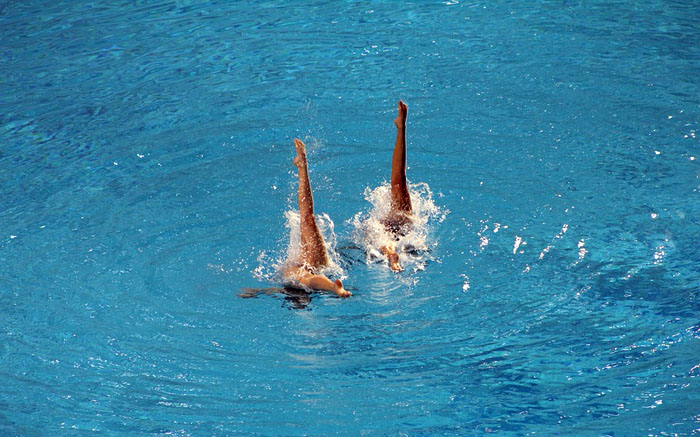
synchronized swimmers synchronized swimmers doing a performance

Artistic Swimming at the 2024 Paris Olympics

The 2024 Paris Olympics marked another spectacular chapter in artistic swimming history, showcasing the sport's evolution with enhanced technical requirements and artistic expression. Athletes from around the world demonstrated remarkable athleticism and precision in the iconic Paris Aquatics Centre.

"You see marathon runners, and at the end of the race, they have pee, puke all over them, and they're barely crossing the finish line, so for us, it's an artistic sport, so we have to present ourselves and make it all look effortless, which of course it's not."

--- Anita Alvarez, USA Olympic Artistic Swimmer

2024 Paris Olympics Medal Results

Paris 2024 Artistic Swimming Medal Winners
Event Gold Silver Bronze
Duet China (Wang/Wang twins) Great Britain (Shortman/Thorpe) Netherlands (de Brouwer twins)
Team China (996.1389 points) USA (First medal in 20 years) Spain

Historic Achievement

China won their first-ever Olympic gold medals in artistic swimming, ending Russia's dominance since Sydney 2000. The Wang twins' victory marked a new era in the sport.

USA's Comeback

Team USA secured silver, their first Olympic medal in artistic swimming in 20 years. After missing the team event since 2008, they returned with a vengeance.

Twin Power

Two sets of twins appeared on the duet podium - China's Wang twins took gold while Netherlands' de Brouwer twins claimed bronze, showcasing family synchronization.

Events at the 2024 Paris Olympics

At the Olympics, artistic swimming features two events:

  • Duet: Two athletes perform technical and free routines
  • Team: Eight athletes perform synchronized routines

The sport follows World Aquatics competition rules, with the latest technical elements showcased at the 2025 Artistic Swimming World Cup. Olympic qualification typically begins two years before the Games, with the World Championships serving as the first qualifier.

The duet competition involves partnerships demonstrating perfect synchronization through both technical and free routines. Technical routines require specific elements performed in a designated order, while free routines allow creative interpretation and choreographic freedom.

Teams must execute complex formations, lifts, and throws while maintaining synchronization among all eight athletes. The judging system evaluates execution, artistic impression, and difficulty, with scores combining technical merit and artistic interpretation.

Event Structure and Requirements

Olympic Artistic Swimming Event Components
Component Duet Team (8 Athletes)
Technical Routine 2:20 duration, 5 required elements 2:50 duration, specific elements
Free Routine 3:00 duration, creative freedom 4:00 duration, choreographic expression
Acrobatic Routine Not applicable 2:30 duration, 7 acrobatic movements
Scoring Focus Synchronization, execution, artistry Formation changes, lifts, synchronization

"Their execution is just out of this world. You see their swims, they are like machines out there."

--- Jacklyn Luu, USA Olympic Team Member, on China's performance

Both events demand extraordinary physical conditioning, as athletes must perform demanding routines lasting between two to four minutes without touching the pool bottom. Athletes train upwards of eight hours daily, developing the cardiovascular endurance needed to perform high-intensity movements while holding their breath for extended periods.

The sport's unique demands include inverted positions, rapid directional changes, and explosive acrobatic movements, all while maintaining facial expressions that convey the routine's emotional narrative.

The next Olympics in Los Angeles 2028 will mark a homecoming for artistic swimming, as the sport made its Olympic debut at LA 1984. Current world rankings following the 2025 World Cup show China, Spain, and Japan leading the qualification race.

2025 World Cup Connection

The 2025 World Aquatics Artistic Swimming World Cup series represents a crucial stepping stone toward the Los Angeles 2028 Olympics, serving as both a competitive showcase and qualification pathway for aspiring Olympic athletes.

Road to LA 2028

Current World Rankings & Olympic Qualification

Following the 2025 World Aquatics Artistic Swimming World Cup:

Current World Leaders:

  • China - 2025 World Cup Champions
  • Spain - Consistent podium finishes
  • Japan - Rising program

The qualification process for LA 2028 follows a comprehensive multi-year pathway designed to ensure the world's best artistic swimmers compete at the Olympics. Our 2025 World Cup results page provides detailed rankings that influence Olympic selection.

Countries accumulate points through various international competitions, with the World Championships serving as the primary qualification events. The system rewards consistency and peak performance, as nations must maintain high standards across multiple competitions to secure their Olympic berths.

Road to LA 2028 Olympic Qualification

Qualification Timeline for LA 2028:

  • 2025: World Cup series (points accumulation begins)
  • 2026: World Championships (first Olympic qualifier)
  • 2027: World Championships (main qualifier)
  • 2028: Continental championships (final spots)

Leading Nations Post-2025 World Cup

China 100%
World #1 - 2025 Champions
Spain 92%
Consistent Podium
Japan 88%
Rising Program
USA 85%
Olympic Silver - Host Nation
LA 2028 Olympic Qualification Timeline
Year Event Qualification Status Spots Available
2025 World Cup Series Points accumulation begins Rankings established
2026 World Championships First Olympic qualifier Top 8 teams qualify
2027 World Championships Main qualifier Additional 6 teams
2028 Continental Championships Final qualification Remaining spots

Continental representation ensures global participation, with specific quotas allocated to each region. Africa, Americas, Asia, Europe, and Oceania each receive guaranteed spots, promoting worldwide development of the sport.

The host nation, United States, automatically qualifies for both duet and team events, while remaining spots are distributed based on world rankings and continental championships. This balanced approach maintains competitive excellence while fostering artistic swimming's growth in emerging nations.

As a result, this will create a truly global Olympic competition that celebrates both established powerhouses and developing programs.

Evolution of Artistic Swimming Techniques

The sport has dramatically evolved since 1984:

Historic Milestones:

  • 1984-1992: Solo events era
  • 1996: Team event introduction
  • 2017: Name change to artistic swimming
  • 2024: New difficulty code implementation
  • 2025: World Cup series expansion

Current Technical Requirements:

Following the March 2024 updates implemented at the 2025 World Cup:

  • Increased acrobatic elements
  • Higher difficulty thresholds
  • Enhanced artistic interpretation scoring
Key Developments in Olympic Artistic Swimming
Period Milestone Impact on Sport
1984-1992 Solo events era Individual artistry emphasized
1996 Team event introduction Expanded to 8-athlete teams
2017 Name change to artistic swimming Recognized athletic demands
2024 New difficulty code implementation Higher technical requirements
2025 World Cup series expansion Enhanced Olympic qualification pathway

"To be creative, you have to be brave. Sometimes you cross a line you didn't want to. But that's often the only way to push the sport and do something people will always remember."

--- Andrea Fuentes, Four-time Olympic Medalist and USA Head Coach

The transformation from synchronized swimming to artistic swimming reflects profound changes in athletic demands and performance expectations. Modern routines incorporate elements previously reserved for gymnastics and acrobatics, including platform dives, multiple rotation throws, and complex stacking formations reaching several meters above water.

These developments have pushed athletes to achieve unprecedented levels of strength and flexibility, with many incorporating cross-training from dance, gymnastics, and even circus arts into their preparation.

Technical evolution has been matched by artistic innovation, as choreographers now blend diverse musical genres and storytelling techniques to create emotionally compelling performances.

The sport's judging system has adapted accordingly, rewarding creative risk-taking and interpretive depth alongside technical precision. Contemporary routines feature rapid transitions between power moves and delicate artistic moments.

These demand versatility that extends far beyond traditional aquatic skills. Athletes must master over 100 distinct positions and movements, from the fundamental ballet leg to complex hybrid figures combining multiple elements.

The 2025 scoring modifications emphasize difficulty progression, encouraging teams to attempt increasingly challenging elements while maintaining artistic cohesion. This balance between technical advancement and artistic expression continues to define the sport's Olympic future, promising even more spectacular performances at LA 2028 and beyond.

Training Requirements & Athletic Demands

Elite artistic swimmers face some of the most demanding training regimens in Olympic sport, combining elements from multiple disciplines. Athletes train upwards of eight hours daily, developing the cardiovascular endurance needed to perform high-intensity movements while holding their breath for extended periods.

Training Calculator - Assess Your Level

Training Components Breakdown

Daily Training Distribution for Elite Athletes

Pool Training 60%
4-5 hours daily
Flexibility/Dance 20%
1.5 hours daily
Strength Training 15%
1 hour daily
Cardio/Cross-training 5%
30 minutes daily

Annual Training Schedule

  • Swimmers and divers: 4 hours/day, 5 days/week, 9 months (39 weeks)
  • Water polo players and artistic swimmers: 5 hours/day, 5 days/week, 10 months (43.5 weeks)
  • Elite athletes: Present at training center for 9.5 months (41.25 weeks) annually

Injury Prevention & Sports Medicine

Understanding injury patterns in artistic swimming is crucial for athlete longevity and performance optimization. Research shows artistic swimmers experience approximately 2.05 injuries per athlete per year[1].

Injury Statistics in Artistic Swimming

Injury Rates and Common Sites in Elite Artistic Swimmers
Injury Type Prevalence Primary Cause Prevention Strategy
Rotator Cuff Tendinopathy 13.6% Repetitive overhead movements Strengthening exercises, proper warm-up
Acute Low Back Pain 13.6% Hyperextension positions Core strengthening, flexibility training
Patellofemoral Syndrome 11.9% Eggbeater kick technique Proper technique, quadriceps strengthening
Overall Injury Rate 1.05 per 1000 hours Training volume Periodization, recovery protocols

Research indicates that artistic swimmers experience approximately 1.05 injuries per 1,000 hours of training[2], with injury rates increasing significantly in youth and junior categories due to higher training volumes.

Swimmers in the youth and junior categories had significantly more injuries than those in the future category, possibly because of more training hours.

Shoulder Health

Sports medicine professionals emphasize rotator cuff strengthening and scapular stabilization exercises to prevent the most common injuries in artistic swimming.

Spine Protection

Core stability training and proper hyperextension techniques are essential for preventing the back injuries common in butterfly and vertical positions.

Recovery Protocols

Elite programs incorporate mandatory recovery periods, with research showing reduced injury rates when athletes have adequate rest between intensive training blocks.

Is Artistic Swimming Right For You?

Answer these questions to assess your compatibility with artistic swimming.

1. How many hours per week can you commit to training?

2. Rate your flexibility level:

3. Do you enjoy team activities?

4. How comfortable are you in water?

Frequently Asked Questions

What's the difference between artistic swimming and synchronized swimming?

Artistic swimming is the current official name for what was previously called synchronized swimming. The name was changed in 2017 by World Aquatics to better reflect the sport's athletic and artistic demands. The sport itself remains the same, combining swimming, dance, and gymnastics performed to music.

How do artistic swimmers stay underwater for so long?

Elite artistic swimmers develop exceptional breath control through specific training techniques. They practice hypoxic training (reduced oxygen exercises), use efficient movement patterns to conserve oxygen, and strategically breathe during brief surface moments. Athletes can hold their breath for up to 45 seconds during intense routines[3].

Can men compete in Olympic artistic swimming?

Starting with Paris 2024, men were eligible to compete in the team event with a maximum of two males per eight-person team. However, no men were selected for Paris 2024. The sport continues to evolve toward full gender inclusion, with expectations for male participation at LA 2028.

What is the egg-beater kick?

The egg-beater kick is a fundamental technique where swimmers alternate circular leg movements to maintain vertical position and stability in the water. This technique allows athletes to keep their upper body above water while performing arm movements and is essential for lifts and vertical positions[4].

How are artistic swimming routines scored?

Routines are scored based on execution (technical precision), artistic impression (choreography, music interpretation, presentation), and difficulty. The new difficulty scoring system introduced in 2024 allows teams to declare their difficulty level, making scoring more objective and rewarding innovation.

What are the physical requirements for artistic swimming?

Artistic swimmers need exceptional flexibility, cardiovascular endurance, muscular strength, and coordination. Athletes typically train 8+ hours daily, combining pool work with dance, gymnastics, and strength training. The sport demands both aerobic and anaerobic fitness due to the intense routines performed while holding breath[5].

How does the LA 2028 Olympic qualification work?

Qualification for LA 2028 spans multiple years, beginning with the 2025 World Cup for ranking points. The main qualification events are the 2026 and 2027 World Championships, where top-finishing teams earn Olympic spots. Continental championships in 2028 provide final qualification opportunities, with the USA automatically qualifying as host nation.

References

  1. Kim et al. (2020). "Injuries in Male and Female Elite Aquatic Sports Athletes: An 8-Year Prospective Study." International Journal of Sports Medicine, 41(8), 521-529.
  2. Vignaud, et al. (2023). "Artistic Swimming Injuries in Young Elite Athletes: An 11-year Follow-Up." Clinical Journal of Sport Medicine, 33(2), 187-195.
  3. NPR Sports. (2024). "Watching artistic swimming? 6 questions about the Olympic sport, answered." Olympic Games Coverage.
  4. Wanivenhaus F, Fox AJS, Chaudhury S, Rodeo SA. (2012). "Epidemiology of Injuries and Prevention Strategies in Competitive Swimmers." Sports Health, 4(3), 246-251.
  5. Mountjoy M, et al. (2016). "Sports injuries and illnesses in aquatic sports." British Journal of Sports Medicine, 50(8), 490-498.
  6. International Olympic Committee. (2024). "Paris 2024 Artistic Swimming Results." Olympics.com.
  7. World Aquatics. (2025). "Artistic Swimming World Cup Results and Rankings." Official competition database.
  8. USA Artistic Swimming. (2024). "Team USA Olympic Performance Analysis." National Team Reports.
  9. Soligard T, et al. (2023). "Olympic Games injury and illness surveillance." British Journal of Sports Medicine, 57(1), 19-27.
  10. American College of Sports Medicine. (2024). "ACSM's Guidelines for Exercise Testing and Prescription." 11th Edition.

Published by: Robert Wood, Topend Sports, August 2025
Last Updated:
Next Review: February 2026

Related Pages