


What is Orienteering?
Orienteering is an endurance sport that involves a huge mental element. It has been described as "running while playing chess". It is easy to learn to participate in and to enjoy the sport, but there are always challenges for people at all levels which makes the sport popular.
To be successful in orienteering, the athlete needs excellent map reading skills, great concentration and the ability to make quick decisions about the best route under pressure while running at high speed.
There is a wide variety of orienteering events: individual competitions and relays, ultra-short park races and mountain marathon events. Night orienteering with the aid of a head lamp is also a popular form of orienteering. Foot Orienteering became a recognized Olympic sport in 1977. The world governing body for foot-orienteering, ski-orienteering, mountain bike orienteering and trail orienteering is The international Orienteering Federation (IOF).
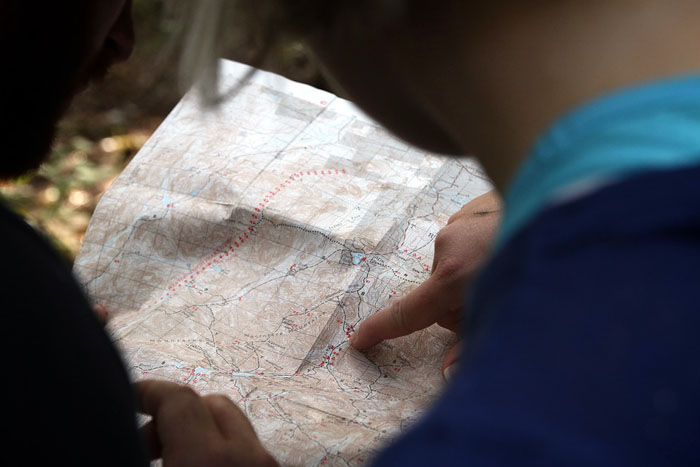 map reading is a core skill of orienteering
Competitive orienteering involves using a detailed map and a compass to navigate around a course with designated control points which are drawn on a map. A supplied map gives detailed information on the terrain that has to be covered - such as hills, ground surface, and any obstacles that may be in the way. Corresponding to the control points drawn on the map are orange and white controls located in the area. Each control marker is located on a distinct feature, such as a stream junction or the top of a knoll. When the control is located, the competitors punch their control cards at each control point, so you can prove you've been there. The winner of the competition is the person who has used the shortest time to visit all the control points in order. The fastest runner will not necessarily win, as you must also choose the best route between the control points, and find the markers without unnecessary wasting of time.
Related Pages
 Any comments, suggestions, or corrections? Please let us know.
 Current Events