Sport in Mongolia
Mongolians do not partake in a large range of sports, but those sports that they do compete in, they do so passionately. The heart of Mongolian sport is the eriin gurvan naadam — the “three games of men” of wrestling, horse racing and archery — contested at the national Naadam festival held every year on 11–13 July, and at hundreds of smaller local naadams through the summer. Naadam was inscribed on UNESCO’s Representative List of the Intangible Cultural Heritage of Humanity in 2010.
Wrestling (bökh) is the national sport and the most prestigious of the three. There are no weight divisions, no age classes and no time limit: a bout is lost the moment any part of a wrestler’s body above the foot — back, knee or elbow — touches the ground. The Naadam tournament is a straight knockout of 512 wrestlers (1,024 in major anniversary years) decided over nine rounds, and the ranks won there — Falcon, Hawk, Elephant, Garuda, Lion and finally Titan — are held for life. Wrestlers enter and leave the arena performing the devekh, the eagle dance, in an open-fronted jacket called a zodog. The benchmark is Badmaanyambuugiin Bat-Erdene, who won 11 national Naadam titles between 1988 and 1999.
Horse racing is the most widely loved of the three games, and no country can match Mongolia’s attachment to the horse. Races are run cross-country over open steppe rather than around a track, over distances from about 10km for two-year-olds up to 26km for the oldest horses, with six age categories in all. The jockeys are children, boys and girls, riding without saddles in many cases; the minimum age was raised to eight in 2022 and helmets and body protection are now compulsory. It is the horse’s breeding and conditioning that is being judged, not the rider, and the first five home in each race are honoured as the airgiin tav, with the winner hailed as tumny ekh, “leader of ten thousand”. Child jockey safety remains a live public issue in Mongolia.
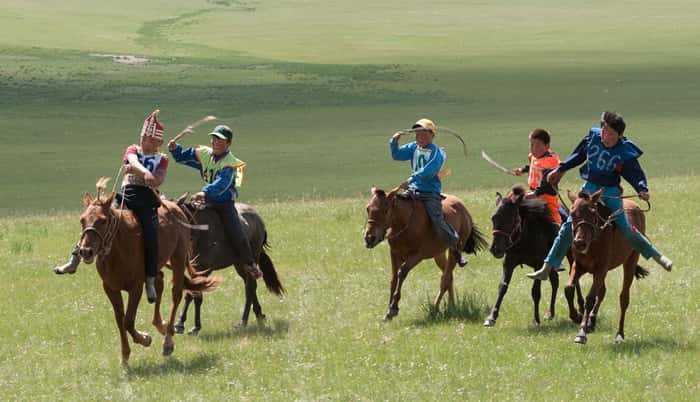 boys racing horses in Mongolia
Archery is the third of the games, and the only one of the three in which women compete at Naadam. Archers shoot at sur — small leather cylinders stacked in a low wall on the ground — from 75m for men and around 60–65m for women, while judges standing beside the targets call “uukhai!” and signal the result with a coded sweep of the arms. The oldest hard evidence of Mongolian archery is the Stele of Genghis Khan, carved around 1224 and now in the Hermitage in St Petersburg, which records a shot of some 500m by the Khan’s nephew Yisüngge. Ankle-bone shooting (shagai harvaa), added to the official Naadam programme in 1998, is effectively a fourth national sport and has its own UNESCO listing, made in 2014.
Beyond the traditional games, Mongolia has become a serious international competitor in the combat sports. It has won 31 Summer Olympic medals, all of them in judo, wrestling, boxing and shooting, and Mongolian wrestlers have long been the raw material of Japanese sumo — five Mongolians have reached the rank of yokozuna, including Hakuhō, the most successful sumo wrestler in history. More recently the country has made an unlikely global name for itself in 3x3 basketball and in esports. Football, basketball, volleyball, ice hockey and athletics are all growing, and Sky Resort on the edge of Ulaanbaatar gives the capital a ski hill within 13km of downtown.
Below are details of sports, sporting events and sports people related to Mongolia. Is there something missing? If you know of something that should be listed here, please let us know.
Popular sports of Mongolia
- Wrestling (both Mongolian bökh and freestyle), horse racing, archery, judo, boxing, football (soccer), basketball (particularly 3x3), volleyball, ice hockey, athletics and sumo
Traditional or Regional Sports
- Mongolian Wrestling (bökh) — the national sport, in which the aim is to get your opponent to touch his upper body, knee or elbow to the ground. No weight classes, no time limit, and titles won at Naadam are held for life.
- Naadam horse racing — cross-country racing over 10 to 26km in six horse age categories, ridden by child jockeys.
- Mongolian archery (surharvaa) — team shooting at a wall of small leather targets, in Khalkh, Buriad and Uriankhai styles.
- Ankle-bone shooting (shagai harvaa) — flicking small tablets along a wooden runner at a row of sheep ankle-bones; on the UNESCO intangible heritage list since 2014, and a Naadam event since 1998.
- Shagai (knucklebones) — games and fortune-telling played with sheep ankle bones, whose four faces represent horse, camel, sheep and goat.
- Shatar — Mongolian chess, played on an 8x8 board with a lord, a snow leopard, camels, horses and carts in place of the familiar pieces.
- Eagle hunting — practised by the Kazakh community of Bayan-Ölgii in the far west, and showcased each October at the Golden Eagle Festival near Ölgii.
- Camel racing and camel polo — contested in the South Gobi, notably at the Thousand Camel Festival.
- Yak Polo — polo played on yaks instead of horses. Note that the Mongolian version was created in the mid-2000s as a tourist attraction rather than being a traditional game; yak polo is also played in northern Pakistan. Yak racing and yak rodeo feature at the annual Yak Festival in the Orkhon Valley.
- Beikou Tarkbei (also called Daur Hockey) — a team sport similar to field hockey, unique to the Daur ethnic group. Note that it belongs to Inner Mongolia, an autonomous region of China, and not to the country of Mongolia.
Mongolia Sporting Success
- Mongolia has won 31 Summer Olympic medals — 2 gold, 12 silver and 17 bronze — in judo (12), wrestling (10), boxing (7) and shooting (2). It has never won a Winter Olympic medal.
- Naidangiin Tüvshinbayar won Mongolia’s first Olympic gold medal in the judo −100kg at Beijing on 14 August 2008. Nine days later Enkhbatyn Badar-Uugan won a second gold in the bantamweight boxing, making Beijing 2008 (two gold, two silver) comfortably Mongolia’s best Games.
- Mongolia’s first Olympic medals came at Mexico City in 1968, when the freestyle wrestlers won four in a single Games — a silver for Jigjidiin Mönkhbat and bronzes for Chimedbazaryn Damdinsharav, Danzandarjaagiin Sereeter and Tömöriin Artag.
- Bavuudorjiin Baasankhüü won silver in the women’s judo −48kg at Paris 2024, Mongolia’s only medal of those Games. She had won the world title in the same division earlier in 2024.
- Mongolia topped the medal table at the 2026 Asian Judo Championships in Ordos, China, with four individual golds and the mixed team title.
- The Mongolian women’s 3x3 basketball team won silver at the 2025 FIBA 3x3 World Cup, played on Sükhbaatar Square in Ulaanbaatar — the country’s first 3x3 World Cup medal, won at home. The men’s team has won the FIBA 3x3 Asia Cup twice, in 2017 and 2023.
- Baatarkhuyagiin Otgonbold won the men’s recurve individual gold at the 2023 Asian Games, Mongolia’s first medal at a major international archery championship.
- Mönkhjantsangiin Ankhtsetseg became world weightlifting champion at 87kg in Tashkent in 2021.
- Mongolia has won 183 medals at the Summer Asian Games, including 28 golds, most of them in wrestling and judo.
- The MongolZ became the first Asian team to reach a Counter-Strike Major grand final, finishing runners-up at the BLAST Austin Major in 2025, then won the Esports World Cup and topped the world team rankings in September 2025.
Great athletes from Mongolia
- Naidangiin Tüvshinbayar (judo) — Olympic champion at −100kg in 2008 and silver medallist in 2012, the first Mongolian to win Olympic gold.
- Enkhbatyn Badar-Uugan (boxing) — Olympic bantamweight champion at Beijing 2008.
- Bavuudorjiin Baasankhüü (judo) — world champion and Olympic silver medallist at −48kg in 2024.
- Mönkhbatyn Urantsetseg (judo) — world champion in 2013 and Olympic bronze medallist in 2021, Mongolia’s most decorated judoka.
- Khashbaataryn Tsagaanbaatar (judo) — world champion in 2009 and Olympic bronze medallist in 2004.
- Jigjidiin Mönkhbat (wrestling) — Olympic freestyle silver medallist in 1968, a darkhan avarga of Mongolian wrestling, and the father of the sumo yokozuna Hakuhō.
- Badmaanyambuugiin Bat-Erdene (Mongolian wrestling) — winner of 11 national Naadam titles between 1988 and 1999 and the most celebrated bökh wrestler of the modern era.
- Munkhbayar Dorjsuren (shooting) — won bronze in the 25m pistol for Mongolia at Barcelona 1992, then emigrated and won a second Olympic bronze in the same event for Germany at Beijing 2008. She competed at six Olympic Games in all and now coaches India’s national pistol squad.
- Otryadyn Gündegmaa (shooting) — silver medallist in the 25m pistol at Beijing 2008.
- Dolgorsürengiin Dagvadorj (sumo wrestling) — Asashōryū, the 68th yokozuna and the first Mongolian to reach the rank, with 25 championships.
- Sugarragchaagiin Byambasüren (sumo wrestling) — Hōshōryū, promoted to yokozuna in January 2025 and the only Mongolian currently holding the rank. He is Asashōryū’s nephew.
- Bat-Ochiryn Ser-Od (athletics) — marathon runner who has competed at six Olympic Games from 2004 to 2024, more Olympic marathons than any other athlete, and who holds the Mongolian record of 2:08:50.
- Mönkhjantsangiin Ankhtsetseg (weightlifting) — world champion in 2021 and a three-time Olympian.
- Baatarkhuyagiin Otgonbold (archery) — Asian Games champion in 2023.
- Khulan Onolbaatar (3x3 basketball) — leader of the women’s team that took World Cup silver in 2025.
- Tsegmediin Batchuluun (chess) — grandmaster since 2012 and the highest rated Mongolian player of all time.
Mongolia Sports trivia
- Judo has now overtaken freestyle wrestling as Mongolia’s most successful Olympic sport, with 12 medals to wrestling’s 10. All ten of the wrestling medals are in freestyle — Mongolia has never won an Olympic medal in Greco-Roman.
- Five Mongolians have been promoted to yokozuna, the highest rank in sumo: Asashōryū, Hakuhō, Harumafuji, Kakuryū and Hōshōryū. Hakuhō left the Japan Sumo Association in June 2025.
- The Mongol Derby is often described as the world’s toughest horse race, covering about 1,000km on semi-wild horses and recreating Genghis Khan’s 13th century messenger relay. It is not a traditional Mongolian event: it was created in 2009 by a British adventure travel company for paying international riders, and holds a Guinness World Record as the longest multi-horse race.
- Mongolia sent its first ever alpine skier to a Winter Olympics at Milan-Cortina in 2026, when Altanzulyn Ariunbat finished 38th in the men’s slalom.
- Mongolia’s Paris 2024 team uniforms, hand embroidered by the Ulaanbaatar label Michel&Amazonka and taking around 20 hours each to make, were widely voted the best outfits of the Games.
- At the 2016 Rio Olympics, two Mongolian wrestling coaches stripped off in protest at the mat after a late scoring decision cost Ganzorigiin Mandakhnaran a bronze medal. Both were banned for three years.
- Mongolia hosted the FIBA 3x3 World Cup in 2025 on an open-air court in the middle of Sükhbaatar Square, drawing a reported 50,000 spectators over the week.
- The Ulaanbaatar Marathon, run on the city’s car-free day in May, drew more than 46,000 entrants across its distances in 2026, making it comfortably the largest participation sporting event in the country.
- Mongolia has never qualified for a football World Cup or an Asian Cup, and was ranked 187th in the world in April 2026. Its one breakthrough came in 2019, when it won a World Cup qualifying tie for the first time, beating Brunei.
- The entire Mongolian Premier League is played at a single ground, the 5,000-capacity MFF Football Centre in Ulaanbaatar.
- Naadam wrestlers are attended by a zasuul, part coach and part herald, who holds the wrestler’s hat and sings his praises between rounds.
- Naidangiin Tüvshinbayar, Mongolia’s first Olympic champion, has been serving a prison sentence since 2022 following the death of a fellow judoka.
- Ulaanbaatar has expressed interest in bidding for the 2038 Asian Games.
Mongolia at major events
- Mongolia at the Summer Olympics — every Games since its debut in 1964 apart from the 1984 boycott, with 31 medals.
- Mongolia at the Winter Olympics — since 1964, missing only 1976, with no medals. Three athletes competed at Milan-Cortina 2026 in cross-country and alpine skiing.
- Mongolia at the Asian Games — 183 medals, including 28 golds. Mongolia is competing at the 2026 Games in Aichi-Nagoya.
- Mongolia at the Asian Winter Games — nine appearances
- Mongolia at the World Judo, World Wrestling and World Boxing Championships, where it is a regular medallist.
Past sporting events hosted in Mongolia
- 1987 — Wrestling World Cup, Ulaanbaatar
- 2001 and 2022 — Asian Wrestling Championships, Ulaanbaatar
- 2007 — Asian Amateur Boxing Championships, at the Wrestling Palace in Ulaanbaatar
- 2017 — the first FIBA 3x3 Asia Cup, won by the Mongolian men
- 2019 — FIBA 3x3 U18 World Cup, Mongolia’s first world championship in a team sport, plus the Asian Artistic Gymnastics Championships
- 2023 — East Asian Youth Games, Ulaanbaatar, 16–23 August, the inaugural edition of the Games with 1,112 athletes from seven nations
- 2025 — FIBA 3x3 World Cup, Ulaanbaatar, 23–29 June; and the 17th World Horseback Archery Championship, the first held in Mongolia
- 2026 — Asian Continental Chess Championship (May–June), Asian Taekwondo Championships (May) and the Asian Eastern Zonal Men’s Volleyball Championship (August)
Upcoming sporting events in Mongolia
- Golden Eagle Festival, near Ölgii in Bayan-Ölgii province, 3–4 October 2026
- Thousand Camel Festival, Ömnögovi, 30–31 January 2027
- FIBA 3x3 Asia Cup, Ulaanbaatar, 31 March – 4 April 2027
- Gobi March six-stage ultramarathon, 20–26 June 2027
Annual sporting events held in Mongolia
- Naadam — the national festival of wrestling, horse racing and archery, held 11–13 July, with local naadams across the provinces through July and August.
- Ulaanbaatar Marathon — held on a Saturday in May since 2014, with full and half marathon, 10km, 5km and family distances.
- Ulaanbaatar Judo Grand Slam — an IJF World Judo Tour event held at the Steppe Arena.
- Ulaanbaatar Open — a United World Wrestling ranking series tournament, usually held at the Buyant Ukhaa Sport Palace in late May or early June.
- FIBA 3x3 World Tour Ulaanbaatar — an annual World Tour stop played on Sükhbaatar Square.
- Mongol Derby — the 1,000km horse endurance race across the steppe, run each August.
- Mongolia Sunrise to Sunset — a 42km and 100km ultramarathon at Lake Khövsgöl, run since 1999, with proceeds going to conservation work in the national park.
- Gobi March — a 250km, six-stage self-supported desert ultramarathon finishing near Karakorum.
- Golden Eagle Festival — eagle hunting, horseback games and racing at Ölgii each autumn.
- Thousand Camel Festival — camel racing and camel polo in the South Gobi in winter.
- Khövsgöl Ice Festival — ice skating, ice wrestling, dog sledding and horse-sleigh racing on the frozen lake at Khatgal in early March.
- Yak Festival — yak racing, yak riding and yak polo in the Orkhon Valley in July.
- The Mongolian Premier League — the top domestic association football competition, played from September to July. FC Ulaanbaatar won the 2025–26 title.
Sporting Facilities in Mongolia
- National Sports Stadium (Central Stadium), Ulaanbaatar — opened in 1958 and holding about 12,500 for football, this is the main venue for the Naadam opening ceremony, wrestling and archery.
- Khui Doloon Khudag — the open steppe about 35km west of Ulaanbaatar where the Naadam horse races are run. There is no track and no grandstand; a temporary ger settlement goes up for the festival.
- AIC Steppe Arena, Ulaanbaatar — the country’s flagship indoor venue, opened in September 2021, seating around 2,600 to 3,600 around a full-size ice rink. Home of the national ice hockey team and host of the Ulaanbaatar Judo Grand Slam.
- Bökhiin Örgöö (the Wrestling Palace), Ulaanbaatar — a 2,500-capacity hall built in the shape of a giant ger, dedicated to Mongolian wrestling.
- MFF Football Centre, Ulaanbaatar — a 5,000-capacity ground that hosts the national team and every match of the Mongolian Premier League.
- M Bank Arena, Ulaanbaatar — the main indoor basketball arena, also used for the 2026 Asian Taekwondo Championships.
- Sky Resort — Mongolia’s first ski area, opened in 2009 on Bogd Khan Mountain about 13km from central Ulaanbaatar, with nine trails and a vertical drop of 191m.
- Mt. Bogd Golf Club — the country’s first international-standard 18-hole course, opened in 2013 on the south-eastern edge of Ulaanbaatar.
- Bogd Khan Mountain and its summit Tsetsee Gun, at about 2,260m on the southern edge of the capital, is Mongolia’s most-used hiking and trail running terrain, and has been a protected area since 1778.
Other
- Mongolia participates in the East Asian Games, and hosted the first East Asian Youth Games in Ulaanbaatar in 2023.
- Mongolian wrestling is the traditional feeder system for Japanese professional sumo, and Mongolians have dominated the top of that sport for more than two decades.
- The MongolZ, an Ulaanbaatar esports organisation founded in 2013, was formally designated a Mongolian national team in February 2025.
Related Pages
 Any comments, suggestions, or corrections? Please let us know.