Tenpin Bowling
Sports > Tenpin > Information > Facilities
Facilities and Dimensions
Lane | Pins | Bowling Ball
Lane
Lane Length
The overall length of a regulation lane is 62 feet 10 3/16ths inches
measuring from the foul line to the pit (Not including the tail
plank). It must be 60 feet from the foul line to the center of the
No. 1 pin spot with a tolerance of 1/2 inch permitted. It must be
2 feet 10 3/16ths inches from the center of the No. 1 pin spot to
the pit (Not including the tail plank).
Lane Width
The lane shall be between 41 and 42 inches in width. The lane plus
the gutters shall not be less than 60 inches nor more than 60 1/4
inches wide.
Lane Surface
The surface must be free of all continuous grooves. A maximum 40/1000th
inch will be permitted in levelness and depth depression.
Lane Approach
Extending back from and exclusive of the foul line there shall be
a clear level approach of not less than 15 feet in length. A tolerance
of 1/4 inch is permitted on depth depression of grooves.
The Pin Deck
The tail plank must be a Maximum of 2 inches in width and the back
line of pins are 3 inches further on. Each pin is 12 inches from
its neighbor in any direction (as measured from the center of
each pin) so the pins are in an equilateral triangle with the head
pin 34 and 3/16ths inches from the tail board.
PINS
Pin Composition: Pins are shaped from Maple wood, which is then coated with a 3/32-inch-thick layer of plastic.
Pin Weight: The pins weigh between 3 lb 6 oz and 3 lb 10 oz.
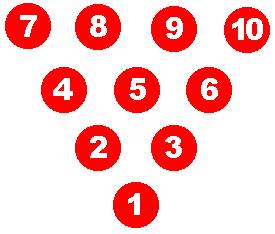
Pin Positions: The diagram to the right indicates the pin numbering system that is commonly used.
Pin Dimensions
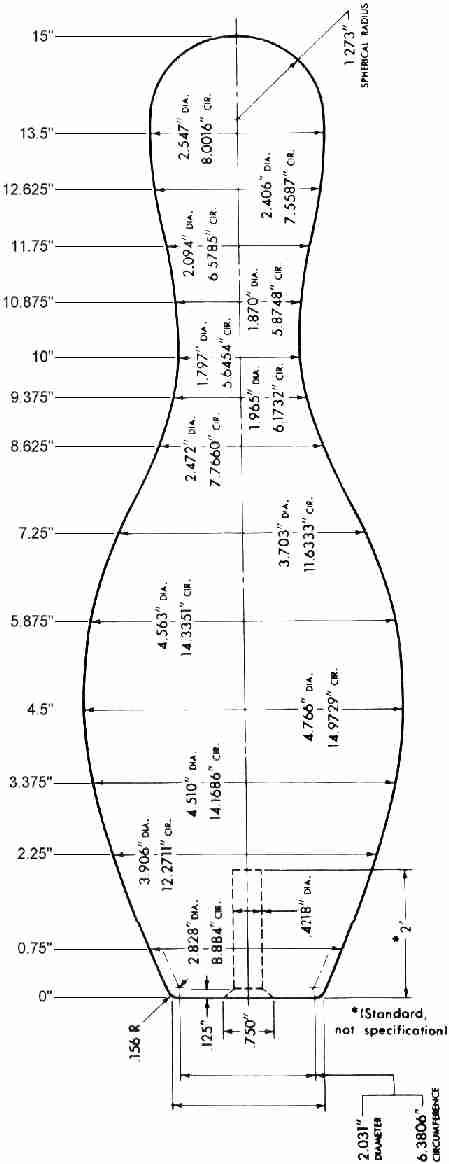
The size and dimensions of each pin is illustrated in the diagram below.
BALL
Bowling Ball Material Regulations
A bowling ball shall be constructed without voids in its interior, be of a non-metallic composition material and conform to the specifications for weight, size and balance. The use of minute reflective particles or flakes for decorative purposes shall be permitted in bowling ball material provided such flakes or particles are made part of the ball at the time of manufacture, are evenly distributed in a uniform pattern under a transparent shell at least 1/4" beneath the surface of the ball so as to have no effect on the balance, and the total amount of such material does not exceed 1/2 ounce per ball. Also, the surface hardness shall not be less than 72 Durometers "D."
So what are they made of?
In the 1960s, hard rubber balls were used. Polyester balls took
over as the ball of choice in the '70s. You will find that most of
the 'house balls' in your local bowling alley are made of the polyester.
In the '80s the urethane ball was developed, which then were further
developed to reactive and proactive urethane.
Bowling Ball Weight, Size, Markings & Holes
- The circumference of a ball shall not be more than 27.002 inches nor less than 26.704 inches, nor shall it weigh more than 16 lbs (there is no minimum weight).
- The diameter of the ball must be constant.
- The surface of the ball must be free of all depressions or grooves of specific pattern, except for holes or indentations used for gripping the ball, identification letters and numbers, and incidental chipping or marring caused by wear.
Other Requirements
- Movable devices are not permitted in a ball except that a device for changing the finger span or size of the finger and thumb holes may be inserted provided it is locked into position during delivery and cannot be removed from the ball without being destroyed.
- The introduction of metal or any other substance no comparable to the original material used in the manufacture of the ball is prohibited.
- Plugs may be inserted for the purpose of re-drilling; ball. Designs may be embedded in a ball as guides or for observation or identification purposes provided the designs are flush with the outer surface of the ball.
- There shall be no interior voids and the plugs or designs must be of similar material to although not exactly the same as the original material out of which the ball was made; and shall otherwise comply with all bowling ball specifications.
- No foreign material may be placed on the outer surface of the
ball.
The surface hardness of a bowling ball shall not be less than 72 Durometer 'D'.
Number of holes allowed
-
see information on the ball drilling page