


Fitness Tests for Football
Fitness testing for the sport of soccer provides valuable information for player development, training program design, injury prevention, and performance enhancement. It assists coaches, trainers, and players in optimizing their physical abilities and achieving their goals on the field.
As with most team sports, there are many components of fitness that are important for success in football (soccer). In football, aerobic fitness is one of the most important attributes, closely followed by anaerobic fitness (running speed and repeat sprint ability) and agility.
Recommended Tests
Below is my recommended battery of fitness tests for soccer players. For each physical attribute there are many other suitable tests that may be used. For information about selecting fitness tests, go here.
Body Fat
Excess body fat affects the football player's ability to move freely around the field, and the extra weight will increase fatigue. Body fat can be measured using the skinfold method. If this is not available, monitoring body weight changes is an alternative to give an indication of body fat changes, assuming no change in muscle mass.
Flexibility
Flexibility is important for mobility and for injury prevention. Good hamstring flexibility is important for football players in the ball kicking skill. The sit and reach test can be done for lower back and hamstring flexibility.
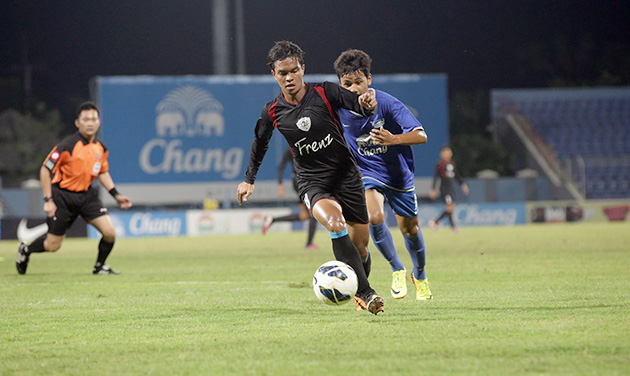 speed is important in soccer
Strength and Power
Strength (and power tests) should also be done to determine strength levels and to monitor strength changes in conjunction with training programs. The vertical jump test can be performed to measure leg power. Maximal strength tests for specific exercises should be conducted.
Speed
Maximum running speed and acceleration are very important in football. Doing a sprint test over 40m, with a split time for the first 10m is appropriate.
Agility
The ability to quickly change direction is very important for football. The 505 agility test is a simple agility test that measures the ability to change direction 180 degrees. There are also more complex tests designed specifically for the demands of soccer such as the Balsom Run, and the Arrowhead Agility is commonly used for soccer players.
Repeat Sprints
Soccer players are required to continually produce short bursts of high intensity work interspersed with lower intensity activity. Repeat sprint tests are designed to measure not only anaerobic power, but also the ability to recover from short bursts of high intensity exercise. You can test just the repeat sprint ability with tests such as Sprint Fatigue Test. For more soccer specific activities designed to simulate the demands of soccer matches, the Loughborough Intermittent Shuttle Test includes jogging, running and sprinting.
Aerobic Fitness
Aerobic fitness is a very important component of fitness for football. Players need to be able to maintain a high intensity throughout the 90 minute game. The shuttle run (beep) test is a simple test to conduct on testing a football team. There are also football specific tests that try to mimic the intermittent nature of the sport, such as the Loughborough Intermittent Shuttle Test and the Yo-Yo Intermittent Tests. There is more information on the numerous other aerobic tests.
Special Considerations
The Goal Keeper
The goalkeeper has very specific fitness demands. Tests for the goalkeeper should concentrate on explosive power and flexibility. Some type of reaction test could also be incorporated.
Example Test Protocols
In 2013, the following test protocol was used by the Milan Soccer Academy. They also test the players in two main technical tests: Dribbling and Finishing.
- Aerobic Endurance: a timed test over 1000 meters at maximum speed, or the Yo Yo Intermittent Recovery Test Level 1.
- Flexibility: sit and reach test
- Strength and Coordination: a series of vertical jump tests to measure leg power and coordination. A counter movement jump (hands on hips) and Abalakov test (with arms). Additionally, a test of sit-ups and push-ups are conducted.
- Speed: measuring reaction speed, maximum speed and his/her technical running movements over a distance of 15 to 20 meters, with and without the ball.
Other testing examples:
- MLS Player Combine
- The Soccer SPARQ fitness testing
- List of previously used tests for the US Women’s National Soccer Team.
- Bayern Munich FC fitness test video — shows many of the tests they conduct (from 2015)
References
- Turner, Anthony & Walker, Scott & Stembridge, Mike & Coneyworth, Paul & Reed, Glen & Birdsey, Laurence & Barter, Phil & Moody, Jeremy. (2011). A Testing Battery for the Assessment of Fitness in Soccer Players. Strength & Conditioning Journal. 33. 29-39.
Related Pages
- Soccer/Football Specific Tests, such as the Footeval Test — a football (soccer) specific fitness test with one-minute intervals incorpoarting ball dribbling.
- Anthropometry for football — about football player's body size and body composition
- Poll about the fitness components for soccer
- Who Is The Fittest Footballer (Soccer Player) Ever?
- MLS Player Combine — entry tests for Major League SOccer players
- Soccer SPARQ fitness testing rating system.
- FIFA Interval Test 1 and Test 2, designed for testing the fitness of soccer referees.
- Fitness testing for the US Women’s National Soccer Team
- Fitness testing for other sports
- About Testing for Intermittent Sports
- Why Fitness Test Your Sports Team
- Fitness for Soccer
 Any comments, suggestions, or corrections? Please let us know.
 Current Events