


Fitness Testing for Cricket
Fitness plays a small though significant part in the success of a cricketer (see fitness for cricket). There are several components of fitness that are important for success for all players. A player's balance and coordination is seen as one of the most important aspects of cricket fitness, followed by speed and power. See more on fitness components for cricket.
There is a large range of fitness tests that can be used. We have listed hundreds of tests here. The yo-yo test, a test of aerobic fitness, has been a well publicized fitness standard for many international cricketers.
Below are examples of some tests that we think are suitable for fitness testing cricket players. There is also information about cricket combines conducted by USA Cricket. There are also a video of a fitness testing session of the Australia Cricket team.
Aerobic Fitness
Aerobic fitness is an important component of fitness for cricket, so that players can reduce the effect of fatigue during long periods of play, and from day to day in multi-day matches. Fitter players will cope better with the heat stress of playing all day in the sun.
The aerobic test performed may depend on the starting fitness level of the players. The yo-yo test is a popular test for national team cricket players. The indian team has recently added the 2km run test to their assessments. A sub-maximal test of aerobic fitness may be suitable, such as a cycle test (Astrand test, Trilevel, PWC170), or the Cooper 12 minute run. For players used to some conditioning exercise, the maximum effort shuttle run (beep) test would be more appropriate. You can find information on many aerobic tests from here.
Flexibility
The flexibility tests should be specific to the actions of cricket. Being flexible enables greater range of movement in the execution of strokes, and may reduce injury in the long term. The sit and reach test can be done for lower back and hamstring flexibility. There are many other flexibility tests, which should be selected based on the appropriateness to the sport of cricket, or can be modified to test specific actions of the sport.
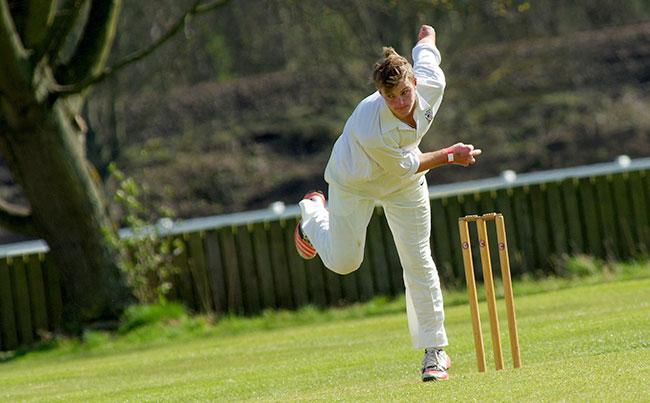 speed in cricket
Strength & Power
Core stability and abdominal function is important in the controlling of movement and execution of strokes. Strength and power tests should also be conducted on cricketers to determine initial levels and to monitor changes in conjunction with training programs.
Maximal strength tests for specific exercises should be conducted. Abdominal muscle function should also be tested, for example using an abdominal strength or endurance test. A hand-grip strength testis also suitable. There is also Cricket Ball Throw Test for testing throwing power and technique.
Speed and agility
Running speed, acceleration, and agility are very important in cricket for moving between the wickets and in fielding. Sprint time over 20m, with a split time for the first 10m should be done (there is a more sport-specific 17.68m cricket sprint test). You may also want to do the run-a-three test, a cricket specific test involving sprinting over the actual pitch distance carrying a bat, incorporating a turn.
Body Size and Composition
Excess body fat would affect the cricketer's ability to move freely around the field, and also increase fatigue during training and game play. Skinfold measures should be performed to determine body fat levels. See more about Anthropmetry in Cricket.
Co-ordination
Coordination is an important fitness attribute for cricket players, though it is not always easy to measure. A coordination test that is quite specific to the actions required in cricket is the alternate hand wall toss, involving throwing and catching a ball.
Balance
Balance and coordination are important for the controlled movements in cricket. There are many general tests of balance that would be suitable to test cricket players, such as the stork balance test
Related Pages
- Fitness for Cricket
- Warm-up for cricket
- Cricket Anthropometry - body size and composition and cricket performance
- The Physical Demands of Professional Cricket — an article by Andrew Gale, a professional cricketer who has played over 100 1st team games for Yorkshire.
- See more on fitness components for cricket, including results of a poll about the fitness components for cricket.
- USA Cricket Combine
- Discussion about Who Is The Fittest Cricket Player Ever?
- See a video of some fitness testing of the Australia Cricket team.
- Cricket Training Programs
 Any comments, suggestions, or corrections? Please let us know.
 Current Events