


History of the Commonwealth Games
The concept
The concept of a united Commonwealth sporting event had been talked about amongst Commonwealth nations since the rebirth of the Olympic Games. A sporting competition bringing together the members of the British Empire was first proposed by Reverend Astley Cooper in 1891, when he wrote an article in The Times newspaper suggesting a "Pan-Britannic-Pan-Anglican Contest and Festival every four years as a means of increasing the goodwill and good understanding of the British Empire".
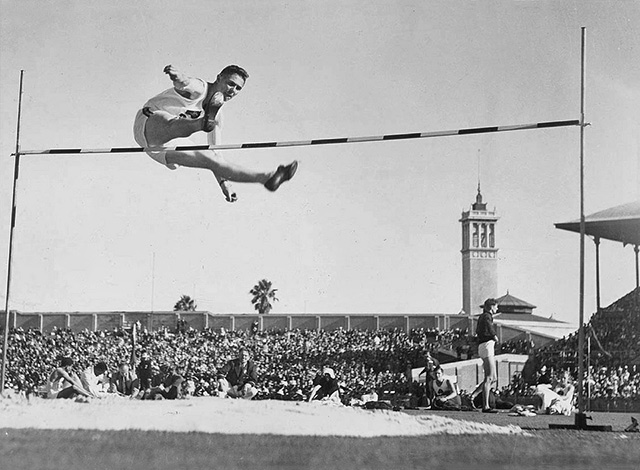 Australian High jumper J.P. Metcalfe at the 1938 Empire Games (image source: state library of NSW)
The Precursor
In 1911, the 'Festival of Empire' was held in London to celebrate the coronation of King George V. As part of the festival, an Inter-Empire Championships was held in which teams from Australia, Canada, South Africa and the United Kingdom competed in events such as boxing, wrestling, swimming and athletics. A trophy in the form of a silver cup, 2ft 6in high and weighing 340oz, the gift of Lord Lonsdale, was presented to the winning country, which was Canada.
The first Games
No further development took place until 1928, when the Olympic Games were in progress in Amsterdam. The splendid feelings of friendliness between the Empire athletes at that Olympiad revitalized the idea for the revival of Empire meetings.
The first Commonwealth Games, known as the British Empire Games at the time, were held in Canada in 1930 in Hamilton, Ontario. 'Bobby' Robinson, who was a major player within athletics in Canada at the time, was the driving force behind the event. The first Games included 400 athletes from 11 countries. To help cover the traveling costs for the visiting nations, the City of Hamilton provided $30,000.
Support for the concept was forthcoming from England, Scotland, Wales and Ireland, with the result that strong teams were sent to Canada. Teams also came from Australia, New Zealand, Bermuda, British Guiana, Newfoundland and South Africa. The events at this meeting comprised track and field athletics, swimming, rowing, boxing and wrestling, and lawn bowls. While no points were allotted, it was fitting that Great Britain filled the premier position.
Ongoing Games
The success of the first Games at Hamilton in 1930 provided enough incentive to make them regular. Since 1930, they have taken place every four years except for 1942 and 1946, when they were disrupted due to World War II. The Melbourne Games are the 16th to be held. From 1930 to 1950 the Games were known as the British Empire Games, then the name was changed to the British Empire and Commonwealth Games until 1962. From 1966 to 1974 they had the title of British Commonwealth Games and from 1978 onwards they have been known as simply the Commonwealth Games (see name changes).
The Friendly Games
While other Games around the globe have been founded on geographic or climatic factors such as the Asian, Pan Am, African Games and Winter Olympics, the Commonwealth Games has been founded on history. A unique characteristic of the Commonwealth Games is being the only Games which share a common language. All athletes and officials can converse with each other in English, creating an atmosphere that has led to the Commonwealth Games being long known as the "Friendly Games".
Host Cities
From the first host city of Hamilton in Canada, the Games have been held in many of the major Commonwealth Countries. Canada again held the Games in Vancouver in 1954, Edmonton in 1978 and Victoria in 1994. Australia has also held the games on four occasions, Sydney in 1938, Perth 1962, Brisbane 1982 and Melbourne in 2006. In 1998, Kuala Lumpur in Malaysia hosted the games for the first time in an Asian country. In 2010, the Games returned to Asia and were held in Delhi. The next Commonwealth Games are to he held in Birmingham, UK in 2022.
More details about each of the Games from 1930 onwards can be found on the individual host pages, which are linked from the list of host cities.
Related Pages
- Commonwealth Games name changes over time
- Commonwealth Winter Games — winter version of the Commonwealth Games, held in St. Moritz, Switzerland from 1958-1966.
- Commonwealth Paraplegic Games — held alongside the Commonwealth Games from 1962 to 1974.
- Commonwealth Games Highlights — some of the memorable moments in Commonwealth Games history.
- David Dixon Award winners list.
- Commonwealth Games Mascots
- Oldest and youngest Commonwealth Games athletes
- All-Time Medal Table — most medals from all Commonwealth Games.
- History of the Olympic Games
 Any comments, suggestions, or corrections? Please let us know.
 Current Events